
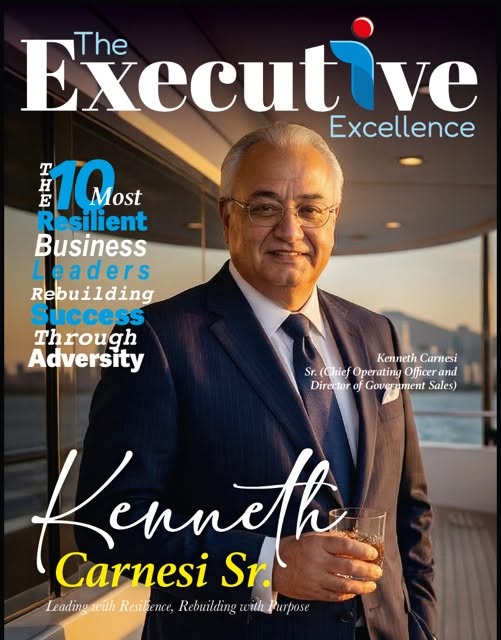
Restitution, Resilience, and the Second Act

On Kenneth Carnesi, Sr.’s Inspirational Trilogy and the unglamorous discipline of rebuilding a life.

An Op-Ed

We are a culture addicted to the comeback. The before-and-after, the redemption arc, the polished LinkedIn confession that tidies five lost years into a single inspirational paragraph. We love the photograph taken at the finish line, and we are largely uninterested in the thousand quieter mornings that preceded it. Yet the most useful books about adversity are almost never written by those who have monetized their hindsight from a safe distance. They are written, instead, by those who can still smell the wreckage. Kenneth Carnesi, Sr., is one of those writers. His Inspirational Trilogy — “After The Fall,” “Get Back Up,” and “Unfinished Business” — is a quiet rebuke to the curated comeback, and a reminder that the second act is not a press release. It is a practice.

Carnesi did not arrive at this subject as an observer. The Brooklyn-born attorney spent decades collecting the credentials that make for an enviable bio: a Juris Doctor from New York Law School, professional certificates from Harvard and Wharton, and a consulting career that carried him through Europe and the former Soviet republics. In 1998, the Vatican ordained him a Knight in the Order of the Poor Knights of Christ; the following year, his knighthood was formally recognized at the Court of St. James in London. By any conventional measure, he had arrived. And then, by his own account, he lost it all — his career, his possessions, the people he had been closest to. The trilogy is what came out the other side.

There are no studies cited in its pages, no borrowed psychological frameworks, no laundered jargon. Carnesi writes from inside the wreckage, then from inside the rebuilding, and finally, most uncomfortably, from inside the work that comes after the rebuilding is supposed to be done. He treats recovery as three stages rather than one, and the structure itself is the argument. To assign each stage its own book is to insist that each deserves its own pace, its own honesty, and its own discipline.

That argument begins with “After The Fall,” the first book and the hardest one. Most contemporary self-help is engineered to skip this part. Hit rock bottom on a Tuesday; receive a five-step action plan by Wednesday. Carnesi refuses. He treats the immediate aftermath as a stage of its own, with its own demands, and he insists the reader stay in it long enough to know what it actually contains. There are no calls to gratitude journals here, no instructions to reframe loss as opportunity. There is, instead, an invitation to sit with what is true: the relationships that have ended, the income that has stopped, the identity that no longer fits. The book’s promise is right on its cover — the raw, honest truth about getting up from a fall that took everything away — and it keeps that promise by refusing to rush.

There is a moral argument buried in this refusal. The cultural reflex to “bounce back” is a flattering one. It implies elasticity, a property of materials that return to their original shape. People are not materials. The fall changes the shape. To pretend otherwise is to skip the only honest inventory available, the one taken before any rebuilding begins. Carnesi’s first book is, in this sense, less a guide than a permission slip. It permits the reader to be where they are, on the floor, before they are told to get up. Anyone who has tried to skip this stage already knows what happens when you skip it. The unprocessed grief shows up later, dressed in different clothes, demanding payment in a less convenient currency.

Then the trilogy tells the reader to get up. “Get Back Up,” the middle volume, is the practical book — the one for the morning you wake up and realize you cannot keep grieving full-time. Its tone is brisker. Its exercises are sharper. Carnesi narrows the field of view to what can be done today, with what is in front of you, and then tomorrow, and then the morning after that. The book is not a sprint to a new version of yourself. It is a quiet argument that small, repeated actions outperform any grand declaration of reinvention. What separates “Get Back Up” from the more familiar literature of comeback is its honesty about lag. There is no calendar by which the reader is supposed to feel better. There is only the work. You make one structured task. You have one difficult conversation. You take one concrete step toward stability. You repeat. The promise is not that the floor stops being the floor; it is that a staircase can be built from where you are, one tread at a time. Read alongside the breathless transformation memoirs that fill airport bookstores, the modesty of this approach is almost radical.

It is the third book, though, that gives the trilogy its weight. “Unfinished Business” is the volume most readers will be tempted to skip, and the one Carnesi seems most invested in. The argument is uncomfortable. You can rebuild your career. You can rebuild your finances. You can rebuild the outward life that once collapsed. And you can still be carrying wreckage, because the personal work is the last work, and the easiest to defer. This is where Carnesi’s lived experience tells. He is writing, plainly, about the relationships that were not repaired, the apologies that were never made, the questions about oneself that the busy years of recovery were useful for avoiding. The book asks the reader to do something the second act rarely demands: to turn back toward the things that did not heal on their own, and to do the harder, slower, less photogenic work of finishing what got abandoned in the fall.

There is a reason most self-help avoids this territory. It does not market well. There is no metric for the relationship you finally repaired, no leaderboard for the conversation you stopped postponing, no quarterly report for the inner reckoning you stopped outrunning. “Unfinished Business” is, in that sense, the trilogy’s most countercultural book — an argument that the visible success of a second act can be its own evasion. The new title, the rebuilt finances, the impressive return: any of them can become camouflage for the work still owed.

The temptation when discussing books like these is to slot them into the long parade of resilience literature and move on. That would be a mistake. Most books in this genre are written by therapists, researchers, and coaches — capable people who have studied hardship from the outside. They synthesize. They abstract. They build frameworks from other people’s case studies. There is a place for that work; some of it is excellent. But Carnesi writes from a different chair. He needed these exercises before he wrote them. He tested them on the only available subject, which was himself, and he kept the ones that worked. The result is a kind of writing that does not have to apologize for its directness, because the directness is what made the recovery possible in the first place. “You already have everything you need to rebuild,” Carnesi has said, and the trilogy is essentially the long form of that sentence.

The trilogy also benefits from being a trilogy. The single-volume recovery memoir is a familiar form, and its weakness is structural: it must compress three different kinds of work into a single shape. Carnesi gives each phase its own book, its own pace, its own exercises. Read in sequence, the trilogy does what the genre rarely does well — it respects the timeline of what it describes. The reader who tries to skim is gently corrected by the architecture itself. You cannot finish “Unfinished Business” without having sat in “After The Fall.”

There is a wider point here worth taking seriously, particularly now, when “rebuilding” has become both an industry and a brand. We have built a culture that loves the visible comeback. We are less interested in the parts that are not visible — the early stage when nothing is photogenic, the long middle when progress is incremental and largely invisible to others, the late stage when the unfinished personal work is finally addressed. The Inspirational Trilogy makes a quiet case that these three stages deserve our patience, our presence, and, occasionally, our books. It is not glamorous work. It is also the only work that holds.

What the reader notices, after the third book, is that Carnesi never quite uses the word “comeback.” His subject is not the bounce. It is the practice. Recovery, in his hands, is not a story told once safely on the other side. It is a discipline adopted while still in the middle of it and continued long after the outward life has been rebuilt. Restitution — the restoration of something taken or lost — is offered here not as a destination but as a working condition. Resilience is not a personality trait. It is a series of small refusals: the refusal to skip the early stage, the refusal to confuse motion for progress in the middle, the refusal to call the work finished before the personal work is done.

The second act, in Carnesi’s telling, is not a press release. It is, on most days, a few specific tasks. One structured exercise. One honest conversation. One thing addressed that had been postponed for a decade. Read at the right point in one’s own life, that is more useful news than any of the louder things the genre tends to offer. It is also harder to package, harder to monetize, and almost impossible to fake — which is precisely what makes the trilogy worth reading. The fall takes everything. The work after the fall is the rest of your life. The Inspirational Trilogy is a guide to doing that work without lying about it, and at a moment when so much of the resilience conversation has been smoothed into a kind of motivational background hum, that is no small thing. Most of us will never need the trilogy. The rest of us will, sooner or later, be grateful it exists.

❖ ❖ ❖

Tagged with: , , , ,
Posted in Uncategorized

All Hope Abandon, Kenneth Carnesi, Sr.’s latest book, is coming soon

Posted in Uncategorized

Bio: Kenneth Carnesi, Sr. , JD, Author, COO

Posted in Uncategorized

https://www.sovereignmagazine.com/article/kenneth-carnesi-awards-all-hope-abandon

Posted in Uncategorized

Collateral Courage

AMERICAN LIVES   |   A LITERARY PROFILE

Collateral Courage

Kenneth Carnesi, Sr.’s new memoir trades the redemption arc for something braver — a steady, unsparing tribute to the family that kept the lights on while he learned to stand again.  

________________________________________________

There is a particular quiet that settles over a South Carolina porch in the hour before dusk — the cicadas pausing as if to listen, the light turning the color of weak tea — and it is in that kind of stillness that Kenneth Carnesi, Sr. seems, at last, to have written the book he had been circling for years.

For three volumes, Carnesi worked the well-trod ground of personal recovery. After The Fall named the wound. Get Back Up reported on the slow craft of standing. Unfinished Business confessed that even a closed wound goes on asking questions of you for the rest of your life. Together, the trilogy earned him the 2026 Evergreen Award for Best New Inspirational Book Author — a recognition that placed him among a small fraternity of writers who treat redemption not as triumph but as homework.

And then he wrote something different.

Collateral Courage, his new book, turns its back on the lectern and looks instead at the pew. It is not, finally, about Carnesi’s Fall. It is about the room his Fall fell into. It is about his wife. It is about his children. It is, in the truest and most literal sense, about everyone else.

THE TURNING POINT

The instinct to write the next inspirational title in a successful series must have been considerable. Readers know the contour of a recovery arc; the publishing economy rewards continuation. To depart from that template — to step aside and hand the microphone to the people who had been off-stage — was, in a sense, the riskiest move Carnesi could make.

But the trilogy, taken together, had always been a kind of staircase. After The Fall described being on the floor. Get Back Up described the ascent. Unfinished Business sat with the work that follows arrival. Each step, in retrospect, had been hollowed out around a question Carnesi had not yet asked aloud: What did this do to the people I love?

Collateral Courage is the book that finally asks it — and, more importantly, lets other people answer.

The result reframes his entire body of work. The trilogy can now be read as a prelude, the recovery of one man recounted in his own voice; the new book belongs to the household. It is a structural decision as much as a moral one. He moves the camera. He widens the frame. He admits the obvious truth that until now had been left for the reader to infer: a Fall is never solitary.

“A Fall is never solitary. It moves through the house. It rearranges conversations, reroutes plans, recalibrates the small daily transactions by which a family knows itself.”

A NARRATIVE OF SHARED ENDURANCE

The American memoir tradition is dense with redemption stories. We are fluent in them. The protagonist falls; the protagonist rises; the protagonist, suitably chastened, hands the reader a coin of wisdom and walks off into the credits. The family, when it appears at all, tends to function as set dressing — a porch light left on, a kitchen table set for one more.

Carnesi has set down a book that refuses to leave them in the wings.

Collateral Courage proceeds from the premise that crisis is contagious. The Fall — capitalized in his telling, as though naming a season — did not stop at the edge of his own body. It moved through the house. It rearranged conversations, rerouted plans, recalibrated the small daily transactions by which a family knows itself. The book attends to those displacements: the missed school plays, the recalibrated holidays, the long looks across a kitchen, the phone calls answered without breathing first.

To read Collateral Courage is to understand that recovery is rarely the project of one person. It is a household enterprise, an effort distributed across people who did not ask to be enlisted but enlisted anyway. The wife who carries on; the child who learns, too young, that adults are not invulnerable; the family that develops a vocabulary for things it never wished to discuss — these are not supporting characters in someone else’s redemption. They are the redemption.

Carnesi seems, finally, to be writing the book he once needed someone else to write for him.

THE EMOTIONAL LANDSCAPE OF COURAGE

The book’s quietest and most arresting move is its working definition of courage. In the trilogy, courage was a verb in the first person — to fall, to rise, to keep on. In Collateral Courage, it becomes something different. A steadiness. A staying. A presence.

Courage, on these pages, is the wife who keeps the family ledger because someone has to. It is the child who learns to read a room. It is the willingness of those nearest to bring a meal to the table without asking how the day went, because asking would itself be a cruelty. It is, again and again, the choice to remain.

This is not the courage of a triumphal narrative. There are no medals. The book’s emotional register is closer to the agricultural — a long season of work, weather to be lived through, a harvest no one quite enjoys but everyone, in the end, knows how to bring in. It is a courage of standing upright in a wind, and the people Carnesi credits are the ones who, by some grace, do not blow over.

There is something corrective in this. The literature of recovery has, for years, suggested that the person at the center of a crisis carries the heaviest weight. Carnesi has offered a thoughtful, almost gentle counter-argument: the person at the center may carry the most visible weight, but the people around them carry a stranger, more diffuse one — the daily weight of pretending things are normal, the long weight of hoping, the unspoken weight of grief that no one yet knows to call grief.

“Courage, on these pages, is not a verb in the first person. It is a steadiness. A staying. The choice to remain.”

A BOON FOR THE UNSEEN

If there is a constituency Collateral Courage was written for, it is a quiet one. The spouses who keep marriages on their feet. The adult children who became their parents’ confidants too early. The siblings who took on the role of family historian because no one else would. The friends who answered the late call.

These are the unseen people in every redemption story, and Carnesi names them. He does not merely thank them — he attributes the durability of his own recovery, at least in part, to them. The book is, in this respect, a counterweight to the heroic register of the inspirational genre. The hero, it turns out, was rarely a soloist.

Readers who have themselves been the steady ones in a family crisis will recognize the textures Carnesi describes: the conversations one learns not to start, the absences one learns to fill, the patience that, in the absence of better language, gets called love. It is hard to imagine a more useful book to press into the hands of someone presently holding a household together while someone they love is busy falling.

That readership has been served largely by other genres — by self-help, by clinical literature, by support groups in church basements. To see them addressed inside a work of memoir, and centered there, is a quietly significant event in inspirational publishing.

❖   ❖   ❖

CELEBRATING A NEW BEGINNING

Carnesi’s career has been an exercise in being honest about consequences. After The Fall would not have worked without the rest; the trilogy would not have worked without his willingness to keep going past the point at which readers might have expected him to stop. Collateral Courage is the natural endpoint of that arc — and, simultaneously, the opening of a new one.

In the publishing context, the move is also an act of self-effacement, the kind that, paradoxically, draws attention. Few authors, having just been recognized as the season’s brightest new voice in their category, would use their next book to point the spotlight away. Carnesi has done so, and in the doing has demonstrated the very form of courage the book is about: the willingness to stay where the spotlight is least flattering and let other people speak.

There is a final, larger argument inside Collateral Courage, and it is one well suited to the present American moment, in which families are asked, more and more frequently, to absorb stresses that used to be borne by institutions. The argument is this: the family is the unit of resilience. Not the individual, who falls and rises and falls again — the family, which keeps the table set.

Whether the reader has lived inside a crisis or outside one, the book leaves a similar residue: a heightened gratitude for the people who never made it into one’s own memoir, and a humbler understanding of what they were doing while one was busy starring in it.

Carnesi has spent four books learning to tell the truth about a Fall. With Collateral Courage, he has finally written the book that returns the favor — a book that lets the people who caught him take, at last, the credit they have always deserved, and a book that leaves the reader, at the close, with the warmth of a porch light that has been left on for a very long time.

Tagged with: , , , ,
Posted in Uncategorized

Between the Pages – Season 2 – May, 2026

Posted in Uncategorized

Podcast Episode: Kenneth Carnesi’s Inspirational Voice

Pip: When the inspirational-writing genre finally makes room for someone who has actually lived the story they’re telling, you notice — because it doesn’t happen that often.

Mara: Today we’re looking at recognition from two separate award bodies for kennethcarnesi and the trilogy behind it: After The Fall, Get Back Up, and Unfinished Business. Let’s start with what that recognition actually says about the work.

A Voice Built on Lived Ground

Pip: The question this coverage raises is whether the awards are recognizing a marketing moment or something with more substance — and the answer turns out to matter quite a bit.

Mara: The National Law Review feature puts it directly. The framing there is that Carnesi “does not serve up hollow platitudes or quick-fix solutions” but instead offers “grounded advice that resonates on a personal level.”

Pip: That distinction is the whole argument. A lot of motivational writing starts at the rebound — the comeback already in progress. After The Fall starts at the impact, sits with it, names it. That’s a different premise entirely.

Mara: And the sequence is deliberate. Get Back Up treats resilience as a practice rather than a personality trait — something repeatable and teachable. Unfinished Business then asks readers to examine the parts of life most people quietly leave alone.

Pip: Fall, rise, finish. As architecture goes, that’s cleaner than most self-help tables of contents — which usually read like a motivational poster exploded into chapters.

Mara: The National Law Review also highlights the quote that runs through the whole collection: “You already have everything you need to rebuild.” No decoration, no qualifier — it assumes the reader is capable and leaves it there.

Mara: The Evergreen Awards piece adds useful context on where this voice comes from. Carnesi’s background includes a BA in English from Brooklyn College and a Juris Doctor from New York Law School — and the piece frames that legal-literary combination as giving the writing both depth and credibility.

Pip: The journey from Brooklyn to Myrtle Beach is part of the texture here too. The Evergreen coverage calls him “Best New Inspirational Book Author in South Carolina” — a second distinct honor, from a different body, landing in the same season.

Mara: The through-line across both pieces is the word “companion.” Not coach, not lecturer — companion. That’s the register the trilogy is operating in, and it’s the reason the recognition feels like it’s tracking something real.

Pip: The kind of resilience that reads like someone telling the truth on a porch — which brings us to what that actually costs a writer to put on the page.


Mara: Two award bodies, one consistent verdict: the work earns the recognition because the honesty came first.

Pip: Fall, rise, finish — and apparently, repeat. We’ll see what comes next.

Tagged with: , , ,
Posted in Uncategorized

Kenneth Carnesi, Sr.: The Inspirational Voice of South Carolina

Review: Inspirational Book Trilogy – Evergreen Awards

In the heart of South Carolina, a voice has emerged that resonates with resilience and hope. Kenneth Carnesi, Sr., an inspirational author, has captured the hearts of many through his powerful storytelling and profound insights. His journey from Brooklyn, New York, to becoming one of South Carolina’s most beloved authors is a testament to the impact of personal experience and the transformative power of words.

A Journey of Resilience

Carnesi’s literary contributions are encapsulated in a trilogy that addresses themes of adversity, self-reflection, and personal growth. His books, After The Fall, Get Back Up, and Unfinished Business, draw from his own life experiences, offering readers a raw and honest perspective on overcoming life’s challenges. The narrative is not merely motivational; it is grounded in emotional honesty and the realities of rebuilding after hardship.

What sets Carnesi apart is his ability to articulate complex emotions and life lessons in a way that is accessible to all. His writing style is clear and relatable, allowing readers from various backgrounds to connect with his messages. This authenticity has earned him recognition, including the prestigious title of “Best New Inspirational Book Author in South Carolina” at the Evergreen Awards in 2026.

Recognition and Influence

Based in Myrtle Beach, Carnesi has quickly become a prominent figure in the literary community. His educational background includes a Bachelor of Arts in English from Brooklyn College and a Juris Doctor from New York Law School. This combination of legal acumen and literary talent enriches his writing, providing depth and credibility.

In addition to his award-winning status, Carnesi’s work has been featured in various publications, further amplifying his influence. His books are celebrated not just for their motivational content but for their ability to inspire readers to engage in self-discovery and personal development. His voice resonates with those seeking guidance through difficult times, making him a cherished figure in the lives of many.

The Heart of His Message

At the core of Carnesi’s writing is a commitment to emotional honesty and practical encouragement. He emphasizes that the path to resilience is not without its struggles, but through perseverance, individuals can find their way back to strength and purpose. His message is clear: it is never too late to start anew.

Kenneth Carnesi, Sr., has carved a niche for himself as an influential and beloved author in South Carolina. His ability to connect with readers through authentic storytelling and relatable experiences has solidified his status as a leading voice in inspirational literature. As he continues to write and inspire, Carnesi invites others to embrace their own journeys of resilience, reminding them that every fall is an opportunity to rise again.

Tagged with: , , , ,
Posted in Uncategorized

The Weight of the Day

A Reflection on Memorial Day

There is a particular kind of quiet that falls over military cemeteries on Memorial Day morning, before the crowds arrive. Row upon row of white headstones catch the early light, each one a precise, understated marker for a life that ended in service to something larger than itself. That quiet is the truest expression of what this day was always meant to be.

Memorial Day was born from grief. In the years after the Civil War, when the country was still raw with loss — over 600,000 dead, families fractured on both sides — communities began gathering at graves to leave flowers and simply bear witness. They called it Decoration Day. It wasn’t a celebration. It was an act of collective mourning, a refusal to let the fallen disappear into abstraction.

That origin matters because somewhere along the way, the day got lighter. The solemnity softened into a long weekend, the long weekend into a cultural permission slip for summer to begin. None of that is wrong, exactly. Joy and remembrance can coexist. But there’s a cost when the foreground and background swap places — when the grill and the cooler become the point, and the fallen become a brief, obligatory mention before the game comes on.

The men and women Memorial Day honors didn’t die for a concept. They died as specific people — with names, with families who still carry the shape of their absence, with futures that were closed off at nineteen or twenty-two or thirty-four. A mother who never saw her son again. A child who grew up with a photograph instead of a father. These are not sentimental abstractions. They are the actual ledger of what the day is asking us to remember.

Honestly, observing Memorial Day doesn’t require solemnity all day long. It asks for a moment — a genuine one — of reckoning with the fact that the freedoms that make the backyard possible were purchased at a price someone else paid in full. Not a transaction to feel guilty about, but a debt serious enough to deserve acknowledgment with something more than a passing thought between servings.

Place a hand over your heart at the ceremony if there’s one nearby. Read a name. Look at a photograph. Let it land.

The barbecue will taste the same. The day will mean more.

Tagged with: , , , ,
Posted in Uncategorized

A Rare Blueprint from the Front Lines

The Future of Bulk Wi-Fi

Business books tend to fall into two camps: those written by theorists who study industries from the outside, and those written by practitioners who have lived inside them for decades. The Future of Bulk Wi-Fi by Kenneth Carnesi, Sr. belongs firmly and impressively to the second category — and it is precisely that distinction that makes it worthy of serious recognition.

Carnesi is the COO of Anaptyx LLC, a South Carolina-based managed service provider that has built a reputation as one of the most capable bulk Wi-Fi operators in the country. His clients range from hospitality operators and government agencies to municipal facilities and homeowner associations — environments where connectivity is not an amenity, it is infrastructure. That firsthand authority gives every page of this book a credibility that cannot be manufactured.

A Leader Forged by Experience and Education

What sets the book apart is the rare combination of professional disciplines Carnesi brings to the subject. He holds a law degree from New York Law School, a specialization in Entrepreneurship and Startups from the Wharton School at the University of Pennsylvania, a Corporate Regulatory Compliance specialization from Penn, and a Certification in Operational Analysis from Stanford. These credentials are not a flourish on the resume — they appear on every page, giving the book its distinctive blend of legal precision, entrepreneurial vision, and operational rigor. Compliance considerations, contract frameworks, and strategic positioning all receive the kind of careful treatment that generic technology overviews consistently fail to deliver.

His biography has been included in Who’s Who in America, and in 2024, he received a Global Recognition Award for his leadership in the IT and bulk Wi-Fi industry. These honors are not incidental — they reflect a career built on measurable impact, principled leadership, and a commitment to raising the standard of what managed service providers can deliver.

A Platform That Redefines the Category

At the heart of the book is Anaptyx’s proprietary Beyond Wi-Fi™ platform, which Carnesi uses as both a case study and a conceptual anchor. Rather than simply delivering internet access, the platform integrates television services, security cameras, access systems, and Wi-Fi locks into a single managed ecosystem. The way Carnesi describes it — not as a product pitch, but as a demonstration of what bulk Wi-Fi can become — transforms the book from a market overview into something closer to a strategic manifesto. The message is clear: bulk Wi-Fi is no longer a utility. For properties willing to lead, it is a competitive advantage.

Written for Decision-Makers

The writing itself is disciplined and plainspoken without being dry. Carnesi respects his readers’ intelligence. He does not oversimplify the technology, but he never lets technical detail overwhelm the strategic argument. Decision-makers in property management, hospitality, and government facilities will find the book approachable, actionable, and unusually well-organized for such a complex subject. His Wharton training anchors its entrepreneurial perspective; his Stanford certification in operational analysis lends a rigor that sets it apart from generic technology overviews. The result is a resource that speaks to both the boardroom and the property management office with equal authority.

A Worthy Goody Award Contender

That The Future of Bulk Wi-Fi has earned a nomination for the 2026 Goody Best Business Book Award in two categories is no surprise to anyone who reads it carefully. It accomplishes something genuinely difficult: it advances the conversation within an industry while serving as an accessible entry point for newcomers. In an era crowded with business books that recycle familiar frameworks, this title offers something refreshingly concrete — a trusted guide, written from experience, at exactly the right moment in the industry’s evolution.

The Goody Award judges would recognize not just a well-crafted book but a genuine contribution to the literature of managed technology services. Carnesi has done what the best business authors do: he has taken years of lived operational knowledge and translated it into a resource that any property professional can open, read, and act upon.

The Future of Bulk Wi-Fi  |  Kenneth Carnesi, Sr.  |  2026 Goody Best Business Book Award

Source

Today’s Read Contributor. “Kenneth Carnesi, Sr., And The Future Of Bulk Wi-Fi.” Today’s Read, March 23, 2026. https://todaysread.com/kenneth-carnesi-sr-and-the-future-of-bulk-wi-fi/

Tagged with: , , ,
Posted in Uncategorized