
In a few days, the United States turns 250 years old. A milestone like this invites celebration, but it also invites inventory — a quieter accounting of what, exactly, has lasted. Nations endure for many reasons: armies, treasuries, geography, luck. What has carried this one through two and a half centuries of war, depression, expansion, and upheaval is not primarily any of those things. It is an idea, set down in forty-five words near the top of the Bill of Rights, that a government answerable to its citizens must let those citizens speak, publish, assemble, and dissent without first asking permission.
“Congress shall make no law… abridging the freedom of speech, or of the press; or the right of the people peaceably to assemble, and to petition the Government for a redress of grievances.” The framers did not bury this principle in an appendix. They put it first among the amendments, ahead of the right to bear arms, ahead of protection against unreasonable search, ahead of the promise of due process. That ordering was not accidental. Every other right in the American system depends, in some fashion, on citizens being able to say that a law is unjust, that an official has overstepped, that a policy should change. Take away the words, and the other rights become privileges granted at the pleasure of whoever holds power, rather than guarantees a free people hold against it.
The framers wrote from experience. They had lived under a crown that prosecuted seditious libel — the crime of criticizing the government, true or not — and that used licensing laws to control what pamphleteers could print. They knew how easily a state, even a well-intentioned one, could mistake the silencing of critics for the maintenance of order. And they were not naive enough to think their own newly formed government was immune to that same temptation. Within a decade of ratification, the temptation arrived: the Sedition Act of 1798, passed by a Federalist Congress and signed by John Adams, made it a crime to publish “false, scandalous, and malicious” criticism of the government. Editors went to prison. The law expired in 1801, and Thomas Jefferson, who had opposed it, let it die rather than renew it. The episode is remembered today not as a partisan scar but as a shared lesson — proof that the impulse to punish unwelcome speech rarely announces itself as tyranny. It arrives dressed as responsibility, as protection of the public from falsehood, as simple common sense. Both parties, in time, came to see it that way.
The courts spent much of the twentieth century refining what the framers had only sketched. In Brandenburg v. Ohio, the Supreme Court held that even speech advocating violence is protected unless it is both intended and likely to produce imminent lawless action — a deliberately high bar. In New York Times v. Sullivan, the Court made it far harder for public officials to use libel law to punish their critics, recognizing that a press too cautious to challenge power has already failed its purpose. And when the American Civil Liberties Union defended the right of a neo-Nazi group to march through Skokie, Illinois, in 1977, it did so on principle, not sympathy: protect the speech you find most repugnant, because the real test of a free-speech culture is never how it treats the speech everyone already agrees with.
That history matters because it shows that defending free expression has never been a project belonging to one side of the aisle. It has always required people to defend speech they personally found offensive, on the theory that the alternative — letting majorities or officials decide which opinions are tolerable — is far more dangerous than any single bad opinion could ever be.
Which is what makes the current moment worth sitting with. The threat to free expression in America today rarely takes the form of a law. Almost no one is jailed for an opinion. The mechanism is quieter and, in some ways, more effective: a coordinated swarm of professional, social, and reputational consequences, deployed not in response to a specific harm but to make an entire category of opinion too costly to voice in public. Losing a job, a platform, or a friendship over a single remark is not new, and accountability for words has always existed and should. What has changed is the speed, scale, and coordination with which it can now be organized, and the breadth of opinion it has come to target — not just the genuinely cruel or false, but the merely unfashionable, the politically inconvenient, the prematurely correct.
Two forces drive this, and both deserve scrutiny. The first is the government, and it is no longer hypothetical. In Murthy v. Missouri, decided by the Supreme Court in June 2024, plaintiffs alleged that federal officials had pressured social media platforms to remove or suppress content related to COVID-19 and the 2020 election, communicating so extensively and forcefully with platform employees that the line between persuasion and coercion blurred. The Court dismissed the case on narrow standing grounds, six to three, without resolving the underlying constitutional question: at what point does government “encouragement” of a private platform’s moderation decisions become the government’s own censorship, exercised through someone else’s hands? The Court left that question for another day. That ambiguity should concern citizens across the political spectrum, because the tool itself is not partisan. Whoever holds federal power next inherits the same capacity to lean on platforms, and the same unresolved question about where the line sits.
The second force is the platforms themselves, now organized and consequential enough to function, in the Supreme Court’s own words from Packingham v. North Carolina, as “the modern public square.” Private companies are not bound by the First Amendment’s text — that text restrains governments, not corporations — but when so much public conversation runs through a small number of privately owned pipes, a decision made in a content-moderation meeting can shape national discourse as surely as any statute. The danger is sharpest precisely where the two forces meet, where government suggestion and platform action become difficult to tell apart, and citizens cannot know whether a removed post reflects a company’s judgment or a government’s wish.
None of this divides cleanly along party lines, and pretending otherwise is part of the problem. The mid-century blacklists that ended careers in entertainment and academia over suspected left-wing sympathies were enabled by government committees and enforced by private institutions eager to avoid trouble. Decades later, social media suppression has more often been a grievance voiced from the right, while coordinated harassment and doxxing campaigns aimed at silencing individuals — often private citizens with no institutional power at all — have just as often come from the left, or from no coherent political direction whatsoever. No faction owns the experience of being silenced, and no faction has clean hands when it comes to doing the silencing. The instinct to make disagreement expensive is a human instinct before it is a political one, and it will keep finding new tools unless citizens of every persuasion agree, together, to set it down.
This is why the right matters more than any single controversy it gets dragged into. Free expression is not simply one freedom on a list alongside others. It is the mechanism by which a self-governing people audits everything else — whether an election was fair, whether a war was justified, whether a policy is working, whether power is being abused. Suppress that mechanism, even informally, even through purely private and voluntary means, and every other right becomes harder to verify and defend. A citizen who can vote but not speak is participating in a procedure, not a democracy.
Much of today’s silencing, in fact, requires no government order and no platform decision at all. It happens earlier, in the quiet calculation a person makes before raising a hand in a meeting, posting an honest opinion online, or asking an uncomfortable question at a town hall, and decides the cost is not worth it. That is consent, freely given, to one’s own silence. It may be the most efficient form of censorship ever devised, because it needs no enforcer. It only needs a culture that has made disagreement feel dangerous rather than normal.
A two-hundred-and-fiftieth birthday is an unusually good occasion to push back against that culture, not through new legislation alone, but through a recovered habit: arguing with people rather than trying to remove them from the conversation. The founding generation did not agree on much. They argued bitterly about the size of government, the morality of slavery, the structure of the courts, and the wisdom of a national bank. What they shared was a working assumption that the argument itself was legitimate — that an opponent who lost a debate did not also lose a livelihood, a platform, or a reputation, merely by virtue of having spoken honestly. That assumption is the actual inheritance worth protecting as the country marks this anniversary. Flags and fireworks commemorate the founding. Defending the right to disagree, out loud, without fear, is what would actually honor it.
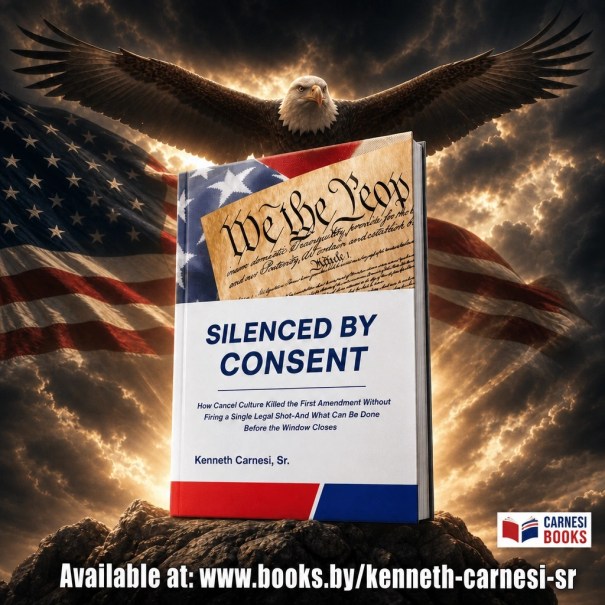
Kenneth Carnesi, Sr. examines this erosion in detail in his book, Silenced by Consent: How Cancel Culture Killed the First Amendment Without Firing a Single Legal Shot — And What Can Be Done Before the Window Closes. Drawing on law, history, and current events, Carnesi argues that the most serious threats to American free expression today rarely take the form of legal prohibitions; they take the form of a slow, voluntary surrender of the will to speak, abetted by both government overreach and the unchecked power of organized social media platforms. The book is available in paperback at www.books.by/kenneth-carnesi-sr.


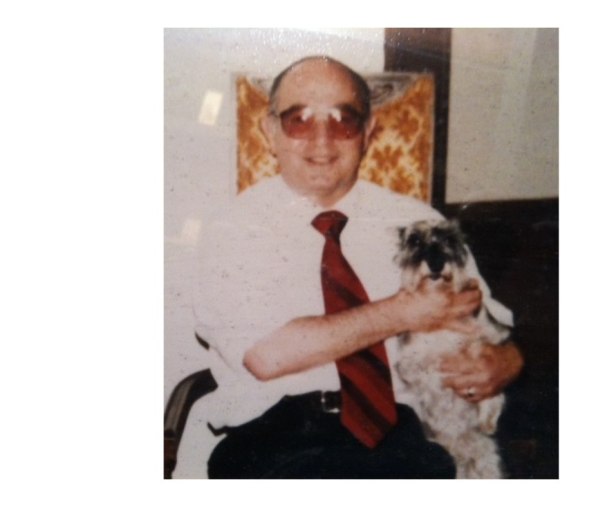



 Kenneth Carnesi, Sr.