
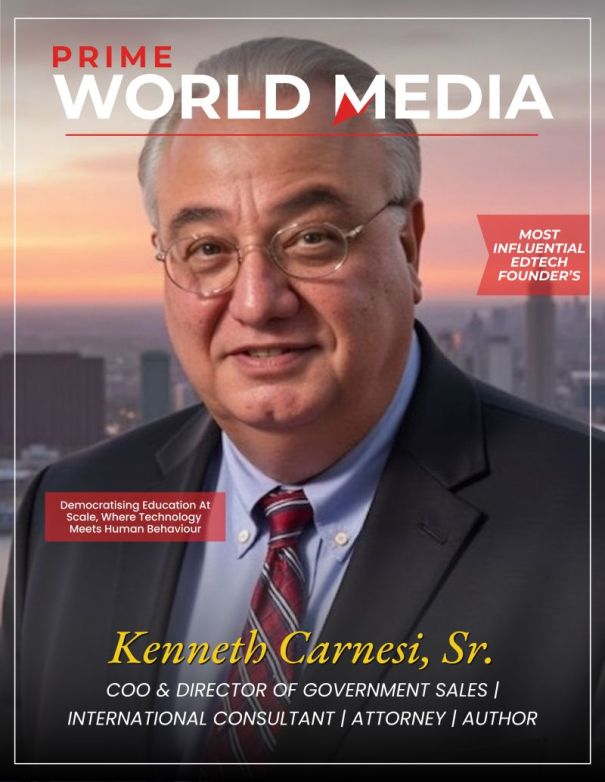
https://primeworldmedia.com/magazine/most-influential-edtech-founders

Two Anchors from Kenneth Carnesi, Sr.’s Book, “Get Back Up“
There are books that teach by argument, and there are books that teach by example, but the rarest kind teaches by conviction — the sense that every sentence has been paid for in advance, by a life actually lived. Kenneth Carnesi, Sr.’s Get Back Up reads like the second kind. Of its many lessons, two stand apart as load-bearing walls holding up the rest of the structure: that perseverance is not a feeling but a decision, and that your word is everything — the real meaning of integrity. Taken separately, each idea is bracing enough to reorganize how a person moves through hardship and through relationships. Taken together, they form something sturdier still: a philosophy of character in which endurance and honesty are not two virtues sitting side by side, but two expressions of the same underlying choice, made and remade, day after day.
Perseverance Is Not a Feeling — It’s a Decision
Most of us were raised on a quieter, more forgiving idea of perseverance — the notion that some people simply have more of it than others, that resilience is a kind of internal weather system, and that on the days it isn’t there, we are excused. Carnesi’s formulation refuses that comfort. By insisting that perseverance is a decision rather than a feeling, he draws a hard line between two categories of human experience that we habitually blur: the things that happen to us and the things we do in response. Feelings arrive uninvited. Discouragement, fatigue, grief, the flat gray sense that nothing is working — none of these wait for permission, and none of them can be reasoned away on command. But a decision is of a different kind. It does not require your cooperation. It only requires your hand on the wheel.
This distinction matters because it relocates the entire struggle. If perseverance were a feeling, then the person who wakes up depleted, who has cried through the night or lost the argument or watched the business fail again, would have a legitimate excuse to stop — the feeling simply isn’t there, and feelings can’t be manufactured. But if perseverance is a decision, then the absence of motivation is not a verdict; it is simply the terrain. You do not need to feel resolved in order to act resolved. You need only choose, in the specific hour you are in, to get back up — which is, not coincidentally, the title Carnesi gives the whole book. The phrase is not a metaphor for optimism. It is an instruction. It assumes the fall. It assumes the moment will come when the feeling of defeat is total and convincing. And it says: rise anyway, because rising was never contingent on how convincing the defeat felt.
There is something almost merciful in this reframing, even though it can sound stern at first. A feelings-based model of perseverance quietly punishes people for the parts of suffering they cannot control — for being tired, for being afraid, for having a bad day precisely when a bad day is unaffordable. A decision-based model does not ask anyone to stop feeling those things. It simply refuses to let the feelings cast the deciding vote. This is, in practice, how most people who have actually endured something difficult describe it afterward. They rarely say the fear left before they acted. They say they acted while still afraid, and the fear either receded later or it didn’t, and it stopped being the point. Carnesi’s insight names what those survivors already knew in their bodies but perhaps never had the language to articulate: courage is not the absence of a feeling; it is the presence of a decision made in spite of one.
It is worth sitting, too, with what this means for how we judge ourselves in the aftermath of failure. If perseverance were simply a feeling we either possess or lack, a setback would be diagnostic — proof that we are not resilient people, that something is missing in our constitution. But if perseverance is a decision, then a setback is just a data point about one moment, not a verdict about one’s character. The next decision is always available, untouched by the last one. This is quietly radical. It means the story is never actually over, because the next chapter only requires a choice, not a feeling that has yet to arrive. Carnesi is, in effect, handing the reader back their own agency at the exact moment despair tries to take it.
Your Word Is Everything — The Real Meaning of Integrity
If the first theme concerns what a person owes to their own unfolding life, the second concerns what a person owes to everyone else who is watching, trusting, and depending on them. “Your word is everything” is, on its surface, a plain piece of old-fashioned wisdom — the kind printed on a needlepoint pillow and half-forgotten by the time we reach adulthood. But Carnesi’s phrasing does something more precise: he does not merely say your word matters; he says it is everything, and then he clarifies that this is what integrity actually means, as opposed to what we have let the word come to mean.
Integrity, in common usage, has drifted toward something vague and internal — a private sense of being a good person, an alignment with one’s own values, largely invisible to others. Carnesi’s definition is more exacting and, frankly, more useful: integrity is not a feeling of inner rightness; it is the measurable consistency between what a person says and what a person does. It is a public, verifiable thing, tested transaction by transaction, promise by promise, over years. You can feel very integrous and still be a person whose word cannot be relied upon. You cannot, by this definition, actually have integrity and also be unreliable, because reliability is not adjacent to the definition — it is the definition.
This is a demanding standard, and its difficulty is exactly the point. Anyone can give their word when circumstances are easy, when keeping it costs nothing and the follow-through requires no sacrifice. The entire test of integrity lives in the gap between the moment a promise was made and the moment it becomes expensive to keep — when keeping it means losing money, admitting fault, disappointing someone you’d rather not disappoint, or simply doing the harder, longer, less convenient thing when the easier path would go unnoticed. Carnesi’s insistence that your word is everything is really an insistence that this gap is where a person’s actual character lives, not in their stated values, not in their intentions, but in what they do when the promise becomes inconvenient, and no one would blame them for quietly letting it go.
There is also a relational dimension here that deserves attention. To say your word is everything is to acknowledge that other people are organizing their own lives and plans, and trusting you, around what you have told them. A broken promise is rarely just a private failure; it is a small betrayal of someone else’s plans, someone else’s faith, someone else’s decision to rely on you rather than build a contingency. Integrity, understood this way, is a form of respect for other people’s dependence on your honesty. It treats a commitment not as a sentiment expressed in a moment of goodwill, but as a debt incurred the instant it is spoken, one that remains outstanding until it is paid in full through action.
Where the Two Themes Meet
Read side by side, these two lessons are not really separate chapters of a philosophy — they are the same discipline applied in two directions. Perseverance is the decision to keep faith with yourself when feeling would counsel surrender. Integrity is the decision to keep faith with others when convenience would counsel a quiet retreat from what you promised. Both demand the same maneuver: separating what you feel in a given moment from what you have already decided is true and binding. Both refuse to let a passing internal state — discouragement in one case, temptation or self-interest in the other — override a commitment made in a clearer moment.
In fact, integrity might be understood as perseverance turned outward, and perseverance as integrity turned inward. To keep your word when it costs you something is simply to persevere in a promise rather than a personal ambition. To get back up after a fall is simply to keep faith with the person you decided, earlier, to become. Carnesi’s Get Back Up ultimately offers a single unified claim beneath its two most memorable lines: character is not what you feel; it is what you do after the feeling has had its say and been overruled. That is a harder standard than the one most of us were taught to live by. It is also, this book insists, the only one sturdy enough to build a life on.
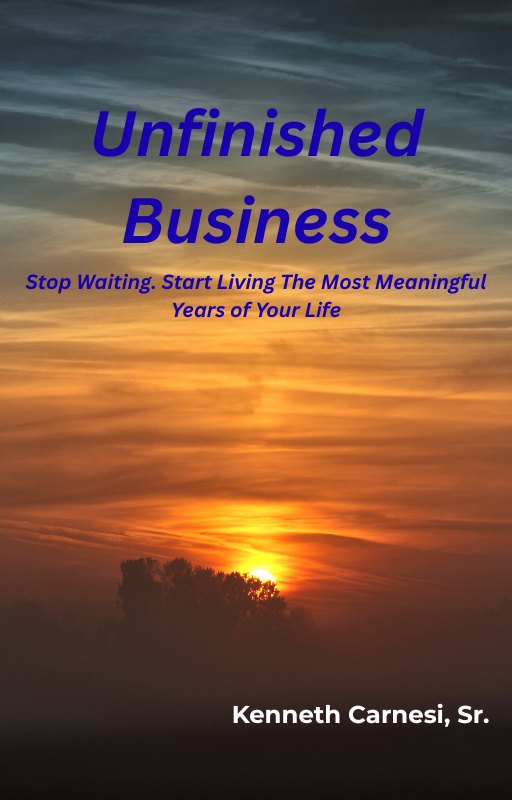
A letter to my children
There’s a strange arithmetic to a life. You spend most of it accumulating — knowledge, possessions, achievements, plans — and then, near the end, you start giving it all back. Not the things so much as what the things taught you. That’s what I want to leave you: not a list of accomplishments, Lord knows, there are not very many of them to leave you with, but rather the handful of truths I’d bet everything on.
I’ve come to believe that character isn’t what you do in front of others. It’s what you do in the empty room. It’s the invoice you correct even though no one would’ve noticed the error in your favor. It’s the promise you keep to a child who has no way of holding you to it. Integrity isn’t a performance — it’s closer to a private agreement you make with yourself about who you’re going to be, and then quietly, unglamorously, keep.
I won’t pretend I always got this right. Nobody does. But I want you to know that the moments I’m proudest of in my own life were never the ones anyone applauded. They were the small, invisible choices to do the harder, honest thing when the easier, dishonest one would have cost me nothing. Build your life on those choices. They compound like nothing else.
And when you fall short — because you will — don’t confuse the failure with your character. Character is revealed in what you do next: whether you own it, repair it, and keep going. That’s the whole practice. Not perfection. Repair.
I want you to remember that I tried to show up. Not perfectly, not every single time, but I tried to be present — actually there, actually listening, actually in the room with you rather than just physically occupying it. If there’s one thing I’d want you to inherit, it’s the instinct to choose presence over almost everything else the world will tell you is more urgent.
Careers end. Money comes and goes. Achievements fade into lines on a resume nobody reads twice. But the people who loved you well, and who you loved well in return — that’s the ledger that actually matters when you get to the end of it. Call your family. Show up for the small moments, not just the milestones. Say the kind thing out loud instead of assuming it’s understood. Love that isn’t spoken and acted on has a way of evaporating before anyone gets the benefit of it.
I want you to build families — of blood or of choice — where showing up is the default, not the exception. Where forgiveness is generous, and grudges are short. Where you’d rather be kind than be right. That’s not weakness. That is, I promise you, the hardest and strongest thing a person can choose to be.
I want to be honest with you here because I think honesty is the only thing that makes the rest of this worth reading.
There were nights I chose work over your bedtime. Trips I took when I should have stayed. Moments you needed me and I was there in body only, my mind somewhere else entirely — on some deadline or worry that, looking back, mattered so much less than I let myself believe at the time. There were seasons I told myself I was building something for you that quietly cost me time with you, and I didn’t understand the trade I was making until the years were already spent.
That regret hasn’t left me. I don’t think it ever fully will, and I’ve made a kind of peace with that. I’m not writing this to be absolved of it. I’m writing it because I don’t know how else to hand you what it taught me.
Here’s what I know now that I wish I’d known sooner: I cannot get that time back. Not one hour of it. There’s no version of this letter that undoes a single missed dinner or distracted conversation. But I can still choose, today and every day I have left, what I do with whatever time remains. That choice is still mine, and I intend to make it count for as long as I’m able.
If I’m honest, that’s the real reason I’m writing this at all. Not to leave you a tidy list of values, but to try to spare you my own regret. I don’t want you to reach the end of something — a career, a chapter, a life — and find yourself doing the math on lost time the way I have. So take this as more than advice. Take it as a father’s plea: don’t wait for some more convenient season to show up for the people you love. Don’t assume there will always be another chance. There wasn’t always one for me, and I’ve carried the weight of that. I’d give almost anything for you to never have to carry it yourself.
If I’ve done nothing else right, let it be this — that my failures became your shortcut. That you got to skip the years it took me to learn what actually mattered, because I was willing to tell you plainly, rather than let you find out the hard way, the way I did.
I won’t romanticize suffering — plenty of it is just suffering, and there’s no lesson worth the price of some of it. But I do want you to know that the hardest seasons of my life did something the easy ones never could: they showed me what I was actually made of, and they taught me that I could survive things I once thought would break me.
Resilience isn’t the absence of being knocked down. It’s not some hardened, unfeeling toughness either. It’s the quiet decision, made over and over, to get back up and keep tending to the people and things you love. It’s allowing yourself to grieve fully and then deliberately choosing to keep building anyway. I want you to know that pain doesn’t disqualify you from a good life — it’s often the very thing that teaches you how to build one that’s real, rather than one that just looks good from the outside.
When your hard seasons come — and they will, because that’s what it means to be alive — I hope you remember that struggle isn’t proof something’s wrong with you. It’s proof you’re doing something that matters. Let it change you. Let it make you gentler with other people who are struggling too, rather than harder toward them.
I’m not leaving you a finished philosophy — I’m leaving you a starting point. Take what’s true here and outgrow the rest. Question it. Improve it. Be better than me. Build something wiser than what I managed, using whatever pieces of this actually held up under the weight of your own life.
If you remember nothing else, remember this: be honest even when it costs you something. Show up for the people you love, again and again, in the unremarkable daily ways as much as the big ones. And when life gets hard — as it will — don’t mistake the difficulty for a verdict on your worth. Get back up, stay soft where it counts, and keep loving the people in front of you.
That’s the inheritance. Everything else is just details.
Kenneth Carnesi, Sr. is the author of an Inspirational Trilogy of books: After The Fall, Get Back Up, and Unfinished Business, which won him the Evergreen Award for 2026 Best New Inspirational Book Author in SC. “After The Fall” also won a Literary Titan Gold Book Award for Non-Fiction Memoir.
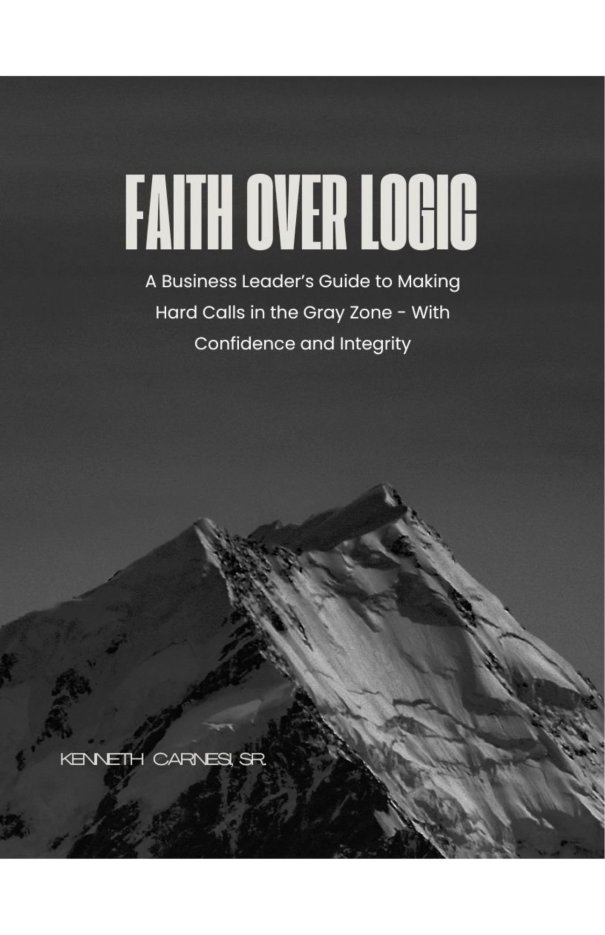
The Honest Faith of “Faith Over Logic” – A Book Review
Every businessperson eventually reaches a moment that no case study prepared them for. The numbers are ambiguous. The people involved are decent, or at least not obviously villainous. The path forward isn’t a clean choice between right and wrong; it’s a choice between two versions of right, or between a small wrong that everyone tolerates and a higher cost that only you seem willing to pay. Maybe it’s a longtime partner who has started cutting corners in ways that are technically defensible. Maybe it’s a valued employee whose performance has quietly slipped and whose family depends on the paycheck. Maybe it’s a client who has been less than truthful, and you’re the only one in the room who seems to notice. There’s rarely a memo for these moments. Kenneth Carnesi Sr.’s book, “Faith Over Logic,” was written for exactly that moment.
What sets the book apart is its refusal to stay theoretical. Each chapter is built around a real category of gray-area decision that businesspeople actually face, not a philosophical exercise dressed up in business language. Difficult partnerships that have quietly soured. Ethical shortcuts that everyone else on the team seems willing to take. The gut-wrenching work of letting someone go, especially someone you respect. Dishonesty from a partner, a client, or a vendor that you can’t quite prove but can feel. The question of when to hold firm on a principle and when the wiser, more faithful choice is actually to walk away. These aren’t abstractions plucked from a business school syllabus. They’re the situations that keep owners and executives up at night, the ones that don’t have a slide deck answer.
For each of these categories, Carnesi does something that few faith-based business books manage: he connects specific Scripture to specific situations. This isn’t a book of vague inspiration, a verse pasted next to a motivational quote and left to do its own interpretive work. It’s a book of direct application. A chapter on confronting dishonesty in a business relationship doesn’t just gesture at “honesty is important” and move on; it walks through what Scripture actually says about confrontation, truth-telling, and reconciliation, and then shows how that guidance plays out in a real negotiation, a real conversation, a real decision made under pressure. The goal is that a reader facing a similar situation on a Tuesday afternoon can open the relevant chapter and find something usable in real time, not just something to meditate on later.
That usability is reinforced by a structure running through the entire book: a clear process for moving from confusion to confidence. Gray-area decisions are disorienting precisely because they resist simple rules. “Faith Over Logic” doesn’t pretend otherwise. Instead, it offers a repeatable way of working through the fog, one that is grounded in faith but built for action rather than contemplation alone. It’s less a philosophy of business ethics and more a field method, something a reader can return to again and again as new gray areas present themselves, because they always do.
That process matters because confusion is where most people get stuck. It’s easy to know, in the abstract, that honesty matters or that people deserve to be treated with dignity. It’s much harder to know what that looks like at ten o’clock on a Thursday morning when a decision has to be made before noon, and every option in front of you carries some cost. Carnesi’s process doesn’t shortcut that difficulty. It gives readers a way to slow down, to bring Scripture and prayer into the actual mechanics of the decision rather than treating faith as a separate compartment from the business one, and to arrive at a choice they can stand behind regardless of how it turns out. The confidence the book aims for isn’t certainty that things will go well. It’s the steadier confidence of knowing you made the decision for the right reasons, in the right way, with the right counsel.
Perhaps the most striking thing about the book, though, is what it refuses to promise. Plenty of faith-and-business writing implies, even if it never says so outright, that integrity and success travel together, that if you do the right thing, God will make sure it works out, that the deal you walked away from on principle will circle back around with something better. Carnesi doesn’t make that promise, because he doesn’t believe it’s true, and he doesn’t think readers are served by a book that pretends it is.
“Faith Over Logic” is honest about the fact that doing the right thing sometimes costs you. Sometimes you choose integrity, and you lose the deal anyway. Sometimes you trust God with a decision and the quarter still ends in red. The book doesn’t treat these outcomes as evidence that you did something wrong, or that your faith wasn’t strong enough, or that some better move existed if only you’d been wiser or prayed harder. It treats them as simply part of the terrain, the same way weather is part of farming. And having named that reality plainly, the book then does the harder work: it offers a faith-based answer for how to carry that kind of loss. Not how to avoid it, because it can’t always be avoided, but how to walk through it without becoming bitter, without drowning in regret, and without quietly abandoning the values that got you to this point in the first place. That combination- honest about cost, unwilling to hand out easy comfort, but still resolutely faithful- is rare in this genre, and it’s the reason the book has resonated with readers navigating decisions where there was no clean win available.
Carnesi’s own background gives the book its credibility. He didn’t write this from a seminar room; he wrote it out of decades of actual business decisions, the kind where the stakes were his own company, his own reputation, and his own relationships with the people who worked for and with him. That lived experience shows up on nearly every page, in the specificity of the scenarios and the plainness of the advice. There is no padding here, no filler chapter added to hit a page count. Each section earns its place because it maps to something readers have actually lived through or will soon face themselves.
That combination of rigor, honesty, and faith has not gone unnoticed. Kenneth Carnesi Sr. was named the 2026 Best Business Guidebook Author in South Carolina by Best of Best Reviews, a recognition of exactly the qualities that make “Faith Over Logic” stand apart from the crowded field of business advice books: specificity, practical usefulness, and a willingness to engage with hard truths rather than smooth them over. He was also named the 2026 Best New Inspirational Book Author in South Carolina by the prestigious Evergreen Awards, an acknowledgment that the book’s spiritual grounding is as substantial as its business insight. Rounding out the recognition, Carnesi’s work has earned two Literary Titan Gold Book Awards, a distinction reserved for books judged on the strength of both their writing and their content. Taken together, these honors reflect what readers who’ve spent time with the book already sense: this is a rare title that satisfies as both a serious business resource and a genuine work of faith, without shortchanging either.
For the business owner staring down a partnership gone sideways, the executive dreading a termination conversation, or the entrepreneur trying to figure out whether a shady arrangement is worth the money it would bring in, “Faith Over Logic” offers something more useful than reassurance. It offers a way of thinking, a way of praying, and a way of acting that doesn’t collapse the first time the outcome doesn’t match the effort. It tells the truth about the cost of integrity, and then it tells the reader how to keep standing after paying that cost. In a genre often accused of oversimplifying, that honesty is the book’s real achievement, and it’s likely the reason its recognition keeps growing alongside its readership.
In the end, “Faith Over Logic” isn’t a promise that faith guarantees a good quarter. It’s a promise that faith can guarantee something sturdier: a way to make hard calls with clarity, to live with their consequences without losing yourself, and to keep showing up as the same person of integrity no matter which way the numbers break. For anyone who has ever made the right call and still watched it cost them something, that may be the more valuable promise after all.
By: Kenneth Carnesi, Sr., JD
The bunting comes down first. Then the folding chairs, the trailers hauling away the stage where the band played, the last sticky puddle of melted ice cream drying on the sidewalk. By the Tuesday after the Fourth, the flags on Main Street are back to half the density, and the country that spent a long weekend celebrating itself returns to arguing with itself, which is, not coincidentally, closer to its natural state. This year the letdown carries extra weight. We have just marked the 250th anniversary of the Declaration of Independence, a milestone most of the men who signed it never expected the country to reach. The question worth sitting with, once the grill is cold, is not whether the party was good. It is what the anniversary was actually for.
In September 1787, as delegates filed out of the Pennsylvania State House after four months of secret, sweltering argument, a Philadelphia matron named Elizabeth Willing Powel reportedly asked Benjamin Franklin what sort of government they had produced. Franklin’s answer survives because Maryland delegate James McHenry copied it into his private notebook that day: “A republic, if you can keep it.” The line is often quoted for its wit and just as often stripped of its edge. Franklin was not offering a toast. He was issuing a diagnosis. He had spent the summer watching brilliant, self-interested men barely stitch together a document that satisfied no one completely, and he understood, better than most, that the harder work was not the drafting but the keeping. A constitution is a set of words on parchment. A republic is a set of habits in a people. Only one of those degrades on its own timeline, and it is not the parchment.
It is worth remembering that the founders were not confident men handing down a finished product. They were anxious men making a bet. Madison, in Federalist No. 10, wrote candidly about the tendency of republics to be torn apart by faction, and he did not pretend the Constitution had solved the problem so much as managed it, distributing ambition against ambition in the hope that no single faction could seize the whole machine. Hamilton, in Federalist No. 1, opened the entire project by admitting that the American experiment would decide, for all mankind, whether societies could actually govern themselves by reflection and choice rather than by accident and force. That is a strange thing to admit at the outset of a sales pitch. It is also honest. The founders knew they were not completing a republic so much as launching a two-hundred-and-fifty-year-and-counting experiment with an uncertain result.
History has obliged them with plenty of moments to test the hypothesis. The first and gravest came four generations later, when Abraham Lincoln stood on a Pennsylvania battlefield and rededicated the country to the proposition Jefferson had written but the country had not yet honored: that all men are created equal. Lincoln understood the Civil War not merely as a fight over union or slavery but as a referendum on Franklin’s warning itself, a test of “whether that nation, or any nation so conceived and so dedicated, can long endure.” He had said something similar twenty-five years earlier, in his 1838 Lyceum Address, warning that America’s danger would never come from a foreign army crossing an ocean. If destruction came, he said, it would rise from among us, from the slow erosion of respect for law and the drift toward mob rule and demagoguery. He called this threat “the silent artillery of time,” a phrase that reads less like nineteenth-century oratory and more like a warning aimed directly at any era that mistakes its own stability for permanence.
The founders themselves argued, almost immediately, about how long any of it should last. In 1789, writing from Paris, Thomas Jefferson told James Madison that “the earth belongs in usufruct to the living,” and that no generation had the right to bind the next with laws or debts stretching beyond its own lifetime; he half-seriously proposed that the Constitution itself should expire every nineteen years and be renegotiated from scratch. Madison, more cautious, wrote back that a society constantly rewriting its founding document would forfeit the stability that makes self-government possible in the first place, that some inherited structure has to hold steady even as the people living under it change completely. Both men were right about something. Jefferson was right that a republic kept alive only by inertia and reverence for old paper is not really being kept at all. Madison was right that constant re-litigation of first principles leaves no foundation sturdy enough to build a life on. The compromise the country actually adopted, an amendable Constitution, changed but rarely and only with broad consent, was itself a bet that the republic could be kept without being remade each generation, provided each generation still chose, actively, to renew it.
The republic was kept in 1865, but only barely, and only at a cost that should embarrass any casual patriotism. It was kept again, unevenly, through Reconstruction’s betrayal and the long night of Jim Crow, through the decades in which the country’s founding promise applied fully to some Americans and only nominally to others. It was kept by the suffragists who spent seventy-two years, from Seneca Falls to the Nineteenth Amendment, insisting that “consent of the governed” could not mean consent of half the governed. It was kept by the marchers at Selma and the lawyers who argued Brown v. Board, who understood, as Lincoln had, that a promise deferred is not a promise honored, and that keeping the republic sometimes means forcing it to become what it always claimed to be. Alexis de Tocqueville, touring the country a half-century after the Constitutional Convention, marveled at Americans’ instinct for forming associations, town councils, juries, churches, mutual aid societies, to solve problems themselves rather than waiting for a distant government to solve them. He also warned, with some prescience, of a “tyranny of the majority” and of a soft despotism that could settle over a democratic people not through violence but through comfort, apathy, and the slow surrender of self-government to convenience. Both observations still describe the country accurately, which is either reassuring or alarming, depending on which one prevails in a given decade.
It would be comforting to say the great tests are behind us, that the twentieth century’s fights against fascism abroad and its slower, incomplete fight for equality at home settled the matter. Watergate offered a genuine, hopeful data point: a president who abused power was checked not by revolution but by the ordinary, unglamorous functioning of courts, a free press, and a Congress willing to act across party lines. The system, tested, held. But Franklin’s warning was never a one-time exam to be passed and filed away. It is a subscription, not a purchase, and every generation’s dues come due on their own schedule. Ours are coming due now, and the symptoms are not exotic. They are the ones Lincoln and Tocqueville both named. A citizenry that increasingly gets its news from algorithms tuned to outrage rather than accuracy. A collapse of local journalism that once made neighbors accountable to one another and now leaves entire counties without anyone covering the school board or the county commission. A slide toward treating fellow citizens who vote differently as enemies rather than as neighbors with a competing theory of the common good. A declining trust in institutions that, whatever their flaws, remain the mechanism by which disagreements get resolved without recourse to force. None of this is fatal by itself. All of it is the “silent artillery of time” doing what it does, quietly, without a single dramatic battle, until a country wakes up and finds the habits of self-government have atrophied.
So, what, concretely, is the work of the next two hundred and fifty years, and what are we actually willing to do?
The first task is the least glamorous and the most important: showing up for the boring parts. Self-government is not sustained by quadrennial passion for a presidential race. It is sustained by people willing to sit through zoning hearings, serve on juries, run for school board, and vote in the primary elections and municipal races that rarely draw a crowd but quietly decide who writes the rules everyone else lives under. Jefferson believed each generation owed the next a functioning republic, not a set of grievances, and he thought the price of that inheritance was ongoing attention, not periodic outrage. That price has not gone down.
The second task is rebuilding the muscle of disagreeing without dissolving the relationship. A republic of thirteen states, and now fifty, spanning a continent and every conceivable religious and cultural background, was never going to agree on much. It was built, by design, to let people disagree loudly and still share a government. That only works if citizens retain the capacity to argue with a neighbor over policy on Tuesday and still wave to them on Wednesday. Restoring that capacity is not a matter for Washington. It happens, or fails to happen, at kitchen tables, in houses of worship, at Little League games, in the thousand small civic spaces Tocqueville admired.
The third task is literacy, in the oldest sense of the word: knowing how the system actually works, what a co-equal branch is for, why a free press with which one disagrees is still worth defending, why the peaceful transfer of power is not a formality but the entire ballgame. A republic cannot be kept by people who do not know what they are keeping. Civic education, allowed to wither for decades, deserves the same seriousness of investment once reserved for science and math.
And the fourth task, harder than the rest, is a willingness to accept outcomes we dislike without concluding the system itself must be discarded. Every generation since 1787 has faced a moment when losing an argument felt unbearable enough to question whether the republic itself was worth the trouble. The ones who kept it were the ones who stayed inside the system to fight another day rather than burning it down to win the current round.
None of this is as stirring as fireworks over a harbor. It will not trend, and it will not fit on a banner. But Franklin’s answer was never a boast. It was a hand extended across two hundred and fifty years, holding something fragile, asking whether we intend to hold onto it too. The parade has ended. The question standing in the driveway, next to the cold grill, is what we do with the ordinary Tuesday that follows it, and the one after that, for as long as we intend the republic to last.
___________________________________________________________________________________________________
Kenneth Carnesi, Sr., JD is the author of the book “ Silenced By Consent,” which discusses the current chilling effects upon First Amendment Rights caused by cancel culture and the increasing challenges faced in the ne
A Letter to the Man I Used to Be
By: Kenneth Carnesi, Sr.
I know you. I know you better than you know yourself right now, sitting there at your desk with your tie a little too tight and your ambition a little too loud. I was you once — thirty years old, certain that the world rewarded the sharpest elbow in the room, that kindness was for people who hadn’t figured out how the game was played. I want to tell you something before you spend forty more years learning it the hard way, the way I did: civility and kindness are not the soft currency of people who can’t afford to be tough. They are the hard currency of people who understand what actually lasts.
You won’t believe me yet. You’re still young enough to think that winning an argument is the same as being right, and that being right is the same as being good. It isn’t. I’ve sat in rooms — boardrooms, courtrooms, church basements, hospital waiting rooms — and watched people confuse volume for strength and coldness for competence. I did it myself. I once fired a man over the phone on a Friday afternoon because it was easier than looking him in the eye, and I told myself it was efficient. It was not efficient. It was cowardice wearing a suit. I think about his face — the face I imagined, since I never saw it — more than I think about almost any deal I closed that year.
Here is the first thing I want you to understand: kindness is not the absence of strength. It is strength that has decided what it’s for. Anyone can be hard. Cruelty takes no skill at all — it’s the default setting of a tired, frightened animal, and we are all, underneath the cufflinks and the credentials, tired, frightened animals some days. What takes skill, what takes a kind of quiet courage nobody claps for, is choosing to be decent to someone when you have every excuse not to be. When you have the leverage. When you could win by being cruel, and nobody would even blame you for it. That’s the moment character shows up or doesn’t. Everything else is just rehearsal.
I spent my thirties and forties in business, and I want to correct something you believe, because I believed it too. You think civility is a luxury tax the truly competitive can’t afford to pay. You think the men who got ahead of you did it because they were willing to be ruthless and you weren’t. Some of them did. But watch them long enough — and I got to watch them for four decades, which is longer than you’ll want to wait — and you’ll see something remarkable. The ruthless ones built companies that people left the moment they had another offer. They built loyalty the way you build a house on sand, and when the tide came in, as it always does, there was nothing there. The people I trusted most, the people who called me at seventy years old just to see how I was doing, were never the sharpest operators in the room. They were the ones who remembered your children’s names, who wrote the note after the funeral, who gave credit away because it cost them nothing, because to them it didn’t. Kindness compounds. Nobody tells you that when you’re thirty because compound interest on decency doesn’t show up on a quarterly earnings report. It shows up in a hospital room fifty years later, when you find out who actually comes.
The second thing, and this one might sting a little more: I want to talk to you about politics, though God knows I never thought I’d care so much about something that used to just be dinner conversation. You’re going to watch, over the coming decades, as civility gets treated like a losing strategy — as something only fools and suckers still practice while everyone else learns to treat the other side as an enemy rather than a neighbor who happens to disagree with you. You’re going to feel the pull of it yourself. You’re going to want to write the cutting comment, share the article that makes the other side look like fools, feel the little hit of righteousness that comes from being certain you’re on the side of the angels. I did all of that. I’m not proud of much of it.
Here’s what I’ve come to believe, sitting here at seventy-three with more of my life behind me than in front of me: contempt is the most expensive thing a person can afford to feel, because it costs you the ability to ever change anyone’s mind, including your own. The moment you decide someone is your enemy rather than your fellow citizen who’s simply wrong about something, you’ve lost the argument, even if you win it. You’ve lost because you’ve given up the possibility of persuasion, of relationship, of the slow, boring, unglamorous work of actually living next to people who see the world differently than you do. Civility isn’t about being right less forcefully. It’s about remembering that the person across from you is going to be there tomorrow, and the day after, and you are going to need each other eventually, whether you like it or not. That’s not weakness. That’s just accurate accounting of how human life actually works.
And now the personal life, which is the part I got wrong most often and where the stakes, it turns out, were highest all along. You are going to be short with your wife on nights when you’re tired and the day went badly, and none of it is her fault. You are going to be impatient with your children in ways you will remember with a specific, sharp regret at three in the morning when you are seventy-three years old, and they are grown and gone, and you cannot get those minutes back to do them differently. I want you to know something now that took me decades to learn: the people closest to you are the ones who most deserve your best civility, and they are also the ones you will be most tempted to deny it to, because you assume their love is a given, a fixed resource that doesn’t require tending. It is not. Kindness at home is no less kindness because no one’s watching. It might be the only kind that actually counts, because it’s the only kind you can’t fake your way through — your family will always know the difference between the man you are and the man you’re performing for strangers.
I want to tell you, too, that kindness is not naivety. You’re going to meet people, plenty of them, who will read your civility as weakness and try to take advantage of it. Some of them will succeed, for a while. It will hurt, and you will be tempted to conclude that the whole project was foolish, that you should have been harder all along. Don’t draw that conclusion. The failure of a few people to meet your decency with their own says something about them, not about the wisdom of the decency itself. You do not stop planting gardens because some years the frost comes early. You get wiser about when and where you plant. But you keep planting.
Here is what I most want you to carry with you, if you carry nothing else from this older man writing to his young and impatient self: civility and kindness never go out of style, not because they are fashionable, but because they answer to something in us that doesn’t change with the decades — the plain, aching human need to be treated like we matter. Every era invents new reasons to believe cruelty is efficient and decency is quaint. Every era is wrong about this in exactly the same way. The boardrooms change, the technology changes, the slogans change, but the woman at the register and the man across the negotiating table and the stranger who cut you off in traffic are all still just trying to get through their day carrying whatever they’re carrying, same as you.
I am seventy-three years old now. I’ve buried friends and made peace with enemies and watched fortunes rise and fall, including my own, more than once. And if I am honest with you, the moments I am proudest of were never the deals I won or the arguments I dominated. They were the small, unremarkable kindnesses — the time I stopped to help a stranger on the street on a cold night when I was already late for a business dinner, the apology I finally made after years of stubborn silence, the way I learned, late but not too late, to listen more than I spoke. Those are the things that didn’t fade. Everything else did.
So be kind, even when it costs you something. Be civil, even when the other side isn’t. Not because it’s easy, and not because you’ll always be rewarded for it in any way you can measure — but because it is, in the end, simply the truer way to be a person, and because forty years from now, you’ll be an old man writing a letter like this one, and I promise you, you will want to be able to say you tried.
With more love than I knew how to show you at the time,
Yourself, Later

Happy 250th, America.
Two hundred fifty years ago, a small group of colonists staked everything on an idea: that people could govern themselves. No king, no crown — just an experiment in liberty, carried forward by generations who believed it was worth the sacrifice.
Today we celebrate that idea, still alive, still imperfect, still ours to protect.
“Government of the people, by the people, for the people, shall not perish from the earth.”
Long shall this Republic endure.
Happy Independence Day. 🎆🇺🇸

A Republic Built on Rules Everyone Can Recognize
By: Kenneth Carnesi, Sr., JD
In a few days, the United States turns 250 years old. There will be fireworks and parades, documentaries and reenactments, the usual pageantry of a nation marking a milestone. But anniversaries like this one are worth more than spectacle. They are an invitation to ask what, exactly, we are celebrating — and whether the thing we are celebrating still exists in the form the founders intended.
The temptation, especially now, is to measure the republic by its outcomes: who won, who lost, whose policies prevailed, whose values are ascendant. But that has never been the deepest source of American legitimacy. The founders did not design a system to guarantee that any particular faction would win. They designed a system that all factions could agree was fair, whether they won or lost. That distinction — between a republic that delivers outcomes we like and a republic whose procedures we trust — is the whole of the American inheritance. It is also the part we are in danger of forgetting.
The founding generation had lived under a system where legitimacy flowed from a person — a king whose word was law, whose favor determined fortune, whose displeasure could end a career or a life. Their revolutionary insight was not merely that this particular king was intolerable, but that the whole model was unstable. Personal rule, however benevolent, is only as good as the person. Systems built around individuals inevitably decay as those individuals age, err, or are replaced by worse successors.
So the framers built something almost perverse for their time: a government designed to survive the mediocrity, and even the malice, of the people who would run it. Checks and balances were not an expression of optimism about human nature. They were a hedge against it. James Madison put it plainly in Federalist No. 51: government itself is “the greatest of all reflections on human nature,” and if angels governed men, no controls would be necessary. Because angels do not govern, the Constitution distributed power, staggered elections, separated branches, and forced ambition to counteract ambition. The genius was not in trusting good people to hold power responsibly. The genius was in building a structure that would function even when power fell into the hands of people who were not especially good.
This is why procedure matters more than any single outcome. A republic that only respects results when it likes them is not really a republic — it is a temporary alliance of convenience, waiting to dissolve the moment the votes go the other way. A republic that respects the process, even when the result is disappointing, is durable. It is a contract, not a transaction.
The country’s founding document was a declaration of principle. Its founding test came a quarter-century later, in 1800, when John Adams — the sitting president — lost his bid for reelection to Thomas Jefferson, his fiercest political rival, in a bitter and personal campaign. In much of the world at that time, transfers of power between rival factions happened through exile, imprisonment, or the sword. Adams handed over the keys peacefully. He did not contest the count, mobilize the army, or declare the election a fraud perpetrated by his enemies. He simply left. Jefferson himself later called it a “revolution” — not because power changed hands, but because it changed hands according to rules both sides accepted, rather than through force.
That precedent held, imperfectly but persistently, for the better part of two centuries. It held through the disputed election of 1876, resolved not by combat but by a congressional commission and a negotiated compromise, however flawed. It held through Watergate, when a president resigned rather than face a process — impeachment — that both parties, and eventually his own, judged rightly grounded. It held through the bitterly contested election of 2000, decided not by street mobs but by the Supreme Court and, crucially, by Al Gore’s concession, delivered with the words that the strength of American democracy depends on the loser accepting the outcome of a fair process.
None of these moments were pleasant. Many of the people living through them were furious, convinced that a grave injustice had occurred. Some of them may have been right. But the republic survived because the losing side, again and again, chose the procedure over the fight. They trusted that the next election, the next appeal, the next Congress would give them another chance — because the rules applied to everyone, including whoever won.
The same logic runs through the country’s greatest expansions of who gets to participate in the process at all. The suffragists who spent decades petitioning, marching, and being arrested for the right to vote were not asking for a different set of rules that favored them. They were asking that the existing rules — the ones already claimed as the birthright of every citizen — actually be applied to everyone the founders’ language had described but excluded. The same is true of the civil rights movement a half-century later, which pursued its aims overwhelmingly through courts, legislatures, and peaceful protest rather than through the violent overthrow its opponents feared and, in some cases, provoked. In each case, the argument that ultimately prevailed was not merely a moral one. It was a procedural one: that a republic claiming to derive its legitimacy from the consent of the governed could not selectively decide whose consent counted. Fairness, in other words, has never been static in America. It has been a standard we have spent two and a half centuries trying to live up to, expanding its reach even as we have sometimes failed to honor it.
If procedural fairness is the foundation, then the erosion of procedural fairness — or even the perception of it — is what cracks the foundation. And this is where the present moment departs from the past in a way worth taking seriously.
Public trust in American institutions has been declining for decades, but the pace of that decline has outstripped the ability of any institution to repair it. Part of the reason is a genuine and growing sense among ordinary citizens that they are unheard — that decisions affecting their lives are made in rooms they cannot enter, by people who do not answer to them in any meaningful way. Part of the reason is a sense of misrepresentation, the feeling that the loudest voices in public life, on every side, do not actually reflect how most people think, live, or want to be governed. And part of the reason, perhaps the most corrosive part, is a visible shortage of accountability: officials who face no real consequence for error or dishonesty, institutions that protect their own before they protect the public, a media and political environment where being wrong rarely costs anyone anything.
None of these problems is new to American life. What is different now is the speed at which perception spreads and hardens. A single lapse in fairness — real or alleged — can circulate to millions of people before any institution has had the chance to investigate, explain, or correct itself. Trust, once a slow-building asset, can now be spent in an afternoon and take years to rebuild, if it can be rebuilt at all. Institutions designed for a world of newspapers and evening broadcasts are trying to maintain their legitimacy in a world of instantaneously amplified outrage. They were not built for that speed, and it shows.
It would be easy, marking two hundred and fifty years, to spend the occasion refighting old arguments — about the founders’ flaws and their virtues, about which party today is truer to their vision, about whose grievances are more legitimate than whose. There is a place for that reckoning; honest history requires it. But an anniversary asks something different of its citizens than a debate does. It asks for renewal — a recommitment to the underlying agreement, not a re-litigation of every dispute that has ever occurred within it.
Renewal does not mean forgetting disagreement. Americans have never agreed about much, and the republic was never built on the premise that we would. It was built on the premise that disagreement, however sharp, could be processed through shared rules rather than settled through force or fraud. What renewal asks is that we distinguish between the disagreements themselves — which are healthy, even necessary, in a self-governing society — and the rules by which we resolve them, which must remain something we hold in common regardless of who currently benefits from them.
This is a harder discipline than it sounds. It requires, first, a return to facts as a shared starting point. Reasoned deliberation is impossible when two sides cannot agree on what happened, let alone what should be done about it. Verification — patient, unglamorous, often unrewarded — has to matter again, not as a partisan cudgel but as a civic habit. Second, it requires a form of civil discourse that has become almost countercultural: the willingness to hear an opposing argument in its strongest form, rather than its weakest caricature, and to change one’s mind when the evidence warrants it. That used to be considered a mark of seriousness. It has come to be treated, in some corners, as a form of weakness or betrayal. Restoring its reputation is itself an act of citizenship.
If we want to remain one republic, we must treat fairness as a national principle — something stronger than party loyalty and more durable than outrage. That is not a call for neutrality on every question, nor an argument that all positions are equally valid. It is a call to separate the question of who is right from the question of whether the process that produced an answer was legitimate. A republic can survive being governed, for a time, by people we disagree with. It cannot survive a widespread belief that the rules themselves are rigged, that the process is merely a costume worn by power.
The founders understood something that is easy to lose sight of in an age obsessed with individual leaders and single elections: a republic’s strength has always come from a system built to outlast personalities. Presidents, senators, judges, and movements come and go. What has endured — through civil war, depression, world war, scandal, and upheaval — is the underlying agreement that power changes hands according to rules everyone can recognize, and that those rules do not bend to whoever currently holds the advantage.
Two hundred and fifty years is a long time for any political experiment to survive, longer than the framers themselves dared to promise. It has survived not because Americans have agreed with one another, but because enough of them, enough of the time, have agreed to disagree inside a shared structure rather than outside it. That is the contract. It was never a guarantee that any of us would get the outcome we wanted. It was a promise that the process would be fair enough, and stable enough, for us to keep trying.
Renewing that promise — not reenacting old fights, not merely appreciating rules that benefit us in the moment but genuinely recommitting to fairness as a standard that binds winners and losers alike — is the actual work this anniversary asks of its citizens. It is less dramatic than fireworks. It is also the only celebration that would truly honor what began two hundred and fifty years ago.
_______________________________________________________
Kenneth Carnesi, Sr. is the author of Silenced by Consent, a book that examines the decline of First Amendment Rights in an age of Cancel Culture and Social Media. He is also named as the 2026 Best Business Guidebook Author in South Carolina by the Best of Best Review and the 2026 Best New Inspirational Book Author in South Carolina by Evergreen Awards. His book, What We Find in the Ashes, won 2026 Best Inspirational Book by BizWeekly, and his book, After The Fall, won a Literary Titan Gold Book Award for non-fiction memoir.
Choosing to Live — Fully, Fiercely, and on Purpose — at 73
— — —
There is a number that has a way of finding you. It does not announce itself loudly or arrive with fanfare. It simply appears one quiet morning while you are pouring your second cup of coffee, and it sits down across the table and waits. For American men, that number is 74 — the age at which the statistical average life ends. When you are 73, that number is no longer an abstraction. It is a neighbor.
How a person responds to that neighborly visit says everything about the quality of the days still ahead. You can draw the blinds, refuse to answer the door, and spend your remaining mornings in a fog of avoidance and low-grade dread. Or you can open the door wide, look the number square in the eye, and say: ” I know. Now step aside, because I have things to do.”
This is not a manifesto of denial. Death is real, and pretending otherwise is a fool’s errand that fools no one, least of all the person doing the pretending. This is something more honest and, ultimately, more life-giving than denial: it is a choice. A deliberate, eyes-open, daily choice to be present — to be an active participant in the time still in front of you, not a passive observer watching the last of your years drift past like leaves on a slow river.
And the difference between a participant and an observer, it turns out, is everything. Participants lean in. They initiate. They say yes to the things that frighten them just enough to matter. Observers wait — for the right moment, for conditions to improve, for some signal that it is finally safe to begin. At 73, the participant understands a truth the observer keeps avoiding: the right moment is almost certainly this one.
— — —
In my book Unfinished Business, I offer a deceptively simple yet extraordinarily demanding challenge: Stop Waiting. Start Living the Most Meaningful Years of Your Life. The title itself is a gentle provocation. “Unfinished business” is the language of regret — of phone calls not made, reconciliations deferred, passions set aside for a tomorrow that never came. But I have tried to reframe the phrase with remarkable generosity. Unfinished business is not a verdict on what you failed to do. It is an invitation to what you can still become.
The book’s central argument is both urgent and tender: these later years are not a postscript. They are not the slow exhale after the real story has been told. They are, for those willing to claim them, among the most potent years of a human life — years shaped by hard-won wisdom, clarified values, and the extraordinary freedom that comes when you finally stop caring about the wrong things. The question that I put to his reader is not “How much time do I have left?” but rather “What will I do with the time that is mine?”
“Choose, right now, to be an active participant in the time still in front of you. Not a passive observer.” Those words land differently at 73 than they would have at 43. At 43, participation in your own life feels assumed, almost automatic. At 73, it is a conscious act of will — and a radical one. It means resisting the cultural narrative that aging is fundamentally about diminishment, about things falling away and opportunities closing. It means insisting, against considerable social pressure to the contrary, that your story is not over, and that the chapters still unwritten may be the most honest and luminous of all.
— — —
The Welsh poet Dylan Thomas understood something essential about this choice. Writing at his dying father’s bedside, he did not counsel acceptance or gentle surrender. He raged — lovingly, desperately, magnificently — against the dying of the light:
“Do not go gentle into that good night,
Old age should burn and rave at close of day;
Rage, rage against the dying of the light.”
Thomas’s fury is often misread as mere bitterness, a refusal to accept the inevitable. But read more carefully, it is something finer than that. It is a plea for aliveness — for the full, undimmed presence of a human being right up until the final moment. The “wise men,” the “good men,” the “wild men,” and the “grave men” he conjures in the poem’s middle stanzas are not raging out of fear. They are raging because they loved being alive. They understood, in the last light, just how extraordinary the gift of consciousness and breath and human connection truly was.
To be 73 and to heed Thomas’s plea is not to shake your fist at the sky in impotent fury. It is to burn — to burn with curiosity, with love, with purpose, with the particular and irreplaceable fire that only comes to those who have lived long enough to know what actually matters. It is to choose, every single morning, to show up for your own life. It is to refuse — quietly, firmly, and with great good humor — to go gentle.
— — —
What does that look like in practice? It looks different for every person, and that is rather the point. For one person, it is finally writing the memoir that has lived in the back of a desk drawer for twenty years. For another, it is mending a relationship with a child or a sibling — doing the hard, vulnerable work of saying: “I was wrong, and I love you, and I don’t want to leave things like this between us.” For another still, it is learning something entirely new — a language, an instrument, a craft — not for any practical reason but simply because the mind still hungers and that hunger deserves to be fed.
My call is populated with people who discovered their most meaningful chapter not in the sprint of youth but in the long, considered stride of their later years. This is not wishful thinking. Developmental psychology has long recognized what researcher Erik Erikson called “generativity” — the deep human drive, particularly pronounced in later life, to contribute something that will outlast us: to mentor, to create, to give. The desire to matter does not diminish with age. In the best cases, it intensifies — refined by decades of experience into something focused, purposeful, and beautifully unafraid.
There is also a particular clarity that arrives in one’s seventies that younger people simply do not possess. You know, by now, which relationships are worth protecting and which conversations are worth having. You know what genuinely delights you and what merely fills time. You have survived losses that you once thought might break you, and you are still here — which means you are, against all odds, astonishingly resilient. That resilience is not incidental. It is the hard currency of a life lived and the foundation upon which an extraordinary final act can be built.
— — —
None of this requires ignoring reality. Seventy-three-year-old bodies have their honest complaints. Knees negotiate. Energy budgets itself differently than it once did. Friends have been lost, and that grief is real and ongoing and deserves to be honored rather than rushed past. The statistics are what they are, and genuine wisdom means holding them clearly — without flinching, without false comfort — rather than pretending they don’t apply.
But here is the thing about statistics: they describe populations, not individuals. They capture averages, not destinies. And even if the average proves precisely correct — even if the number across the table is telling the truth about the year — there is still today. There is still this week. There is still whatever remarkable stretch of time remains, and every single day of it is an unrepeatable gift. The question is never how many days are left. The question is always what you do with the one in front of you.
My call is not to pretend mortality away. It is to refuse the slow shrinkage that happens when fear of endings causes us to stop beginning things. It is to resist the temptation of the half-life — the years spent watching rather than doing, waiting rather than choosing, dimming gradually rather than burning as brightly as the remaining fuel allows. The candle that is carefully rationed goes out just as surely as the one that burns with abandon. Might as well burn beautifully.
— — —
At 73, standing in the particular light of this morning, the invitation is clear and urgent: Do not shrink. Do not settle into the sofa of diminished expectations and call it peace. There is a kind of peace that is actually surrender, dressed in comfortable clothes and calling itself contentment. It looks nothing like the hard-won serenity of someone who has chosen — truly chosen, day after day — to be fully alive.
Rage, as Dylan Thomas meant it, is not anger. It is vitality. It is the refusal to go quietly before your time, even if your time is closer now than it once was. It is the insistence that your light — the particular, irreplaceable light of your experience, your love, your perspective, your voice — deserves to keep shining. Not because the statistics grant you permission, but because you do.
The most meaningful years of your life are not behind you. They are the ones you choose to make meaningful, starting now — with this breath, this conversation, this small brave decision to begin something you have been postponing. The business is unfinished. The light is still yours.
Burn.
— — —
Inspired by Unfinished Business: Stop Waiting. Start Living the Most Meaningful Years of Your Life. by Kenneth Carnesi Sr.




 Kenneth Carnesi, Sr.