
Podcast Episode: Kenneth Carnesi’s Inspirational Voice

Pip: When the inspirational-writing genre finally makes room for someone who has actually lived the story they’re telling, you notice — because it doesn’t happen that often.
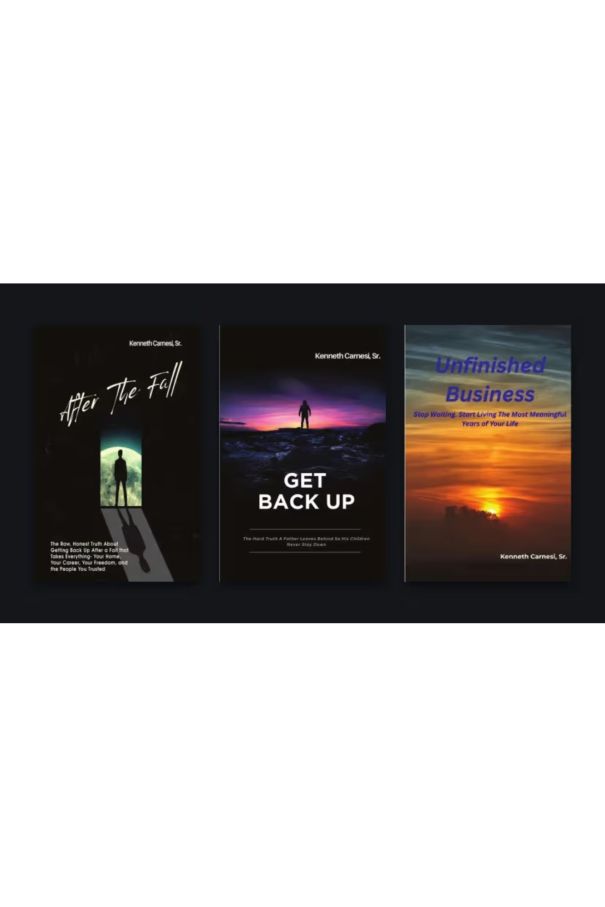
Mara: Today we’re looking at recognition from two separate award bodies for kennethcarnesi and the trilogy behind it: After The Fall, Get Back Up, and Unfinished Business. Let’s start with what that recognition actually says about the work.
A Voice Built on Lived Ground
Pip: The question this coverage raises is whether the awards are recognizing a marketing moment or something with more substance — and the answer turns out to matter quite a bit.
Mara: The National Law Review feature puts it directly. The framing there is that Carnesi “does not serve up hollow platitudes or quick-fix solutions” but instead offers “grounded advice that resonates on a personal level.”
Pip: That distinction is the whole argument. A lot of motivational writing starts at the rebound — the comeback already in progress. After The Fall starts at the impact, sits with it, names it. That’s a different premise entirely.
Mara: And the sequence is deliberate. Get Back Up treats resilience as a practice rather than a personality trait — something repeatable and teachable. Unfinished Business then asks readers to examine the parts of life most people quietly leave alone.
Pip: Fall, rise, finish. As architecture goes, that’s cleaner than most self-help tables of contents — which usually read like a motivational poster exploded into chapters.
Mara: The National Law Review also highlights the quote that runs through the whole collection: “You already have everything you need to rebuild.” No decoration, no qualifier — it assumes the reader is capable and leaves it there.
Mara: The Evergreen Awards piece adds useful context on where this voice comes from. Carnesi’s background includes a BA in English from Brooklyn College and a Juris Doctor from New York Law School — and the piece frames that legal-literary combination as giving the writing both depth and credibility.
Pip: The journey from Brooklyn to Myrtle Beach is part of the texture here too. The Evergreen coverage calls him “Best New Inspirational Book Author in South Carolina” — a second distinct honor, from a different body, landing in the same season.
Mara: The through-line across both pieces is the word “companion.” Not coach, not lecturer — companion. That’s the register the trilogy is operating in, and it’s the reason the recognition feels like it’s tracking something real.
Pip: The kind of resilience that reads like someone telling the truth on a porch — which brings us to what that actually costs a writer to put on the page.
Mara: Two award bodies, one consistent verdict: the work earns the recognition because the honesty came first.
Pip: Fall, rise, finish — and apparently, repeat. We’ll see what comes next.
Kenneth Carnesi, Sr.: The Inspirational Voice of South Carolina
Review: Inspirational Book Trilogy – Evergreen Awards
In the heart of South Carolina, a voice has emerged that resonates with resilience and hope. Kenneth Carnesi, Sr., an inspirational author, has captured the hearts of many through his powerful storytelling and profound insights. His journey from Brooklyn, New York, to becoming one of South Carolina’s most beloved authors is a testament to the impact of personal experience and the transformative power of words.
A Journey of Resilience
Carnesi’s literary contributions are encapsulated in a trilogy that addresses themes of adversity, self-reflection, and personal growth. His books, After The Fall, Get Back Up, and Unfinished Business, draw from his own life experiences, offering readers a raw and honest perspective on overcoming life’s challenges. The narrative is not merely motivational; it is grounded in emotional honesty and the realities of rebuilding after hardship.
What sets Carnesi apart is his ability to articulate complex emotions and life lessons in a way that is accessible to all. His writing style is clear and relatable, allowing readers from various backgrounds to connect with his messages. This authenticity has earned him recognition, including the prestigious title of “Best New Inspirational Book Author in South Carolina” at the Evergreen Awards in 2026.
Recognition and Influence
Based in Myrtle Beach, Carnesi has quickly become a prominent figure in the literary community. His educational background includes a Bachelor of Arts in English from Brooklyn College and a Juris Doctor from New York Law School. This combination of legal acumen and literary talent enriches his writing, providing depth and credibility.
In addition to his award-winning status, Carnesi’s work has been featured in various publications, further amplifying his influence. His books are celebrated not just for their motivational content but for their ability to inspire readers to engage in self-discovery and personal development. His voice resonates with those seeking guidance through difficult times, making him a cherished figure in the lives of many.
The Heart of His Message
At the core of Carnesi’s writing is a commitment to emotional honesty and practical encouragement. He emphasizes that the path to resilience is not without its struggles, but through perseverance, individuals can find their way back to strength and purpose. His message is clear: it is never too late to start anew.
Kenneth Carnesi, Sr., has carved a niche for himself as an influential and beloved author in South Carolina. His ability to connect with readers through authentic storytelling and relatable experiences has solidified his status as a leading voice in inspirational literature. As he continues to write and inspire, Carnesi invites others to embrace their own journeys of resilience, reminding them that every fall is an opportunity to rise again.
The Weight of the Day

A Reflection on Memorial Day
There is a particular kind of quiet that falls over military cemeteries on Memorial Day morning, before the crowds arrive. Row upon row of white headstones catch the early light, each one a precise, understated marker for a life that ended in service to something larger than itself. That quiet is the truest expression of what this day was always meant to be.
Memorial Day was born from grief. In the years after the Civil War, when the country was still raw with loss — over 600,000 dead, families fractured on both sides — communities began gathering at graves to leave flowers and simply bear witness. They called it Decoration Day. It wasn’t a celebration. It was an act of collective mourning, a refusal to let the fallen disappear into abstraction.
That origin matters because somewhere along the way, the day got lighter. The solemnity softened into a long weekend, the long weekend into a cultural permission slip for summer to begin. None of that is wrong, exactly. Joy and remembrance can coexist. But there’s a cost when the foreground and background swap places — when the grill and the cooler become the point, and the fallen become a brief, obligatory mention before the game comes on.
The men and women Memorial Day honors didn’t die for a concept. They died as specific people — with names, with families who still carry the shape of their absence, with futures that were closed off at nineteen or twenty-two or thirty-four. A mother who never saw her son again. A child who grew up with a photograph instead of a father. These are not sentimental abstractions. They are the actual ledger of what the day is asking us to remember.
Honestly, observing Memorial Day doesn’t require solemnity all day long. It asks for a moment — a genuine one — of reckoning with the fact that the freedoms that make the backyard possible were purchased at a price someone else paid in full. Not a transaction to feel guilty about, but a debt serious enough to deserve acknowledgment with something more than a passing thought between servings.
Place a hand over your heart at the ceremony if there’s one nearby. Read a name. Look at a photograph. Let it land.
The barbecue will taste the same. The day will mean more.
A Rare Blueprint from the Front Lines
The Future of Bulk Wi-Fi
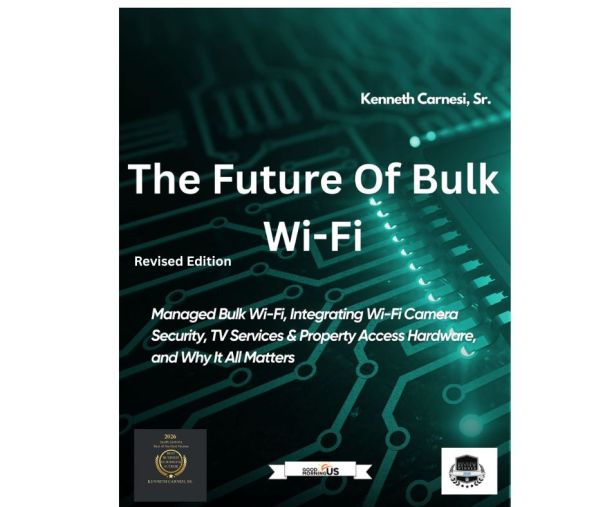
Business books tend to fall into two camps: those written by theorists who study industries from the outside, and those written by practitioners who have lived inside them for decades. The Future of Bulk Wi-Fi by Kenneth Carnesi, Sr. belongs firmly and impressively to the second category — and it is precisely that distinction that makes it worthy of serious recognition.
Carnesi is the COO of Anaptyx LLC, a South Carolina-based managed service provider that has built a reputation as one of the most capable bulk Wi-Fi operators in the country. His clients range from hospitality operators and government agencies to municipal facilities and homeowner associations — environments where connectivity is not an amenity, it is infrastructure. That firsthand authority gives every page of this book a credibility that cannot be manufactured.
A Leader Forged by Experience and Education
What sets the book apart is the rare combination of professional disciplines Carnesi brings to the subject. He holds a law degree from New York Law School, a specialization in Entrepreneurship and Startups from the Wharton School at the University of Pennsylvania, a Corporate Regulatory Compliance specialization from Penn, and a Certification in Operational Analysis from Stanford. These credentials are not a flourish on the resume — they appear on every page, giving the book its distinctive blend of legal precision, entrepreneurial vision, and operational rigor. Compliance considerations, contract frameworks, and strategic positioning all receive the kind of careful treatment that generic technology overviews consistently fail to deliver.
His biography has been included in Who’s Who in America, and in 2024, he received a Global Recognition Award for his leadership in the IT and bulk Wi-Fi industry. These honors are not incidental — they reflect a career built on measurable impact, principled leadership, and a commitment to raising the standard of what managed service providers can deliver.
A Platform That Redefines the Category
At the heart of the book is Anaptyx’s proprietary Beyond Wi-Fi™ platform, which Carnesi uses as both a case study and a conceptual anchor. Rather than simply delivering internet access, the platform integrates television services, security cameras, access systems, and Wi-Fi locks into a single managed ecosystem. The way Carnesi describes it — not as a product pitch, but as a demonstration of what bulk Wi-Fi can become — transforms the book from a market overview into something closer to a strategic manifesto. The message is clear: bulk Wi-Fi is no longer a utility. For properties willing to lead, it is a competitive advantage.
Written for Decision-Makers
The writing itself is disciplined and plainspoken without being dry. Carnesi respects his readers’ intelligence. He does not oversimplify the technology, but he never lets technical detail overwhelm the strategic argument. Decision-makers in property management, hospitality, and government facilities will find the book approachable, actionable, and unusually well-organized for such a complex subject. His Wharton training anchors its entrepreneurial perspective; his Stanford certification in operational analysis lends a rigor that sets it apart from generic technology overviews. The result is a resource that speaks to both the boardroom and the property management office with equal authority.
A Worthy Goody Award Contender
That The Future of Bulk Wi-Fi has earned a nomination for the 2026 Goody Best Business Book Award in two categories is no surprise to anyone who reads it carefully. It accomplishes something genuinely difficult: it advances the conversation within an industry while serving as an accessible entry point for newcomers. In an era crowded with business books that recycle familiar frameworks, this title offers something refreshingly concrete — a trusted guide, written from experience, at exactly the right moment in the industry’s evolution.
The Goody Award judges would recognize not just a well-crafted book but a genuine contribution to the literature of managed technology services. Carnesi has done what the best business authors do: he has taken years of lived operational knowledge and translated it into a resource that any property professional can open, read, and act upon.
The Future of Bulk Wi-Fi | Kenneth Carnesi, Sr. | 2026 Goody Best Business Book Award
Source
Today’s Read Contributor. “Kenneth Carnesi, Sr., And The Future Of Bulk Wi-Fi.” Today’s Read, March 23, 2026. https://todaysread.com/kenneth-carnesi-sr-and-the-future-of-bulk-wi-fi/
The Cost of Independence: A New Author’s Journey to Self-Publishing without Compromise

The allure of self-publishing is captivating many aspiring authors. The promise of creative control, direct engagement with readers, and higher royalty rates is enticing. However, for those who choose to eschew the well-trodden paths of platforms like Amazon and Kindle Publishing, there are unique costs—both tangible and intangible—to navigate. This article explores the multifaceted costs of independence for a new author who prioritizes authenticity over algorithms.
Financial Costs of Self-Publishing
Self-publishing can be a double-edged sword. On one hand, it provides authors with the freedom to publish their work without the gatekeeping of traditional publishing houses. On the other hand, it often entails high upfront costs. Here are some key expenses to consider:
– Editing and Proofreading: Quality editing is crucial for any book, whether traditionally published or self-published. Hiring a professional editor can cost anywhere from a few hundred to several thousand dollars, depending on the depth of editing required.
– Cover Design: A professionally designed cover can make a significant difference in attracting readers. While some authors may attempt DIY designs, hiring a professional cover designer typically costs $300 to $1,500.
– Formatting: Preparing a manuscript for print and digital formats requires technical expertise. Hiring a formatter can cost between $100 and $500, depending on the book’s complexity.
– ISBNs and Distribution: Authors need to purchase ISBNs (International Standard Book Numbers) if they want to sell their books through multiple retailers. ISBN costs can vary, and distribution services often charge fees for listing books on various platforms.
– Marketing and Promotion: Unlike authors who rely on the algorithms of established platforms for visibility, independent authors must actively market their work. This might include social media advertising, book launch events, and promotional giveaways, which can add up quickly.
Time Investment
While financial costs are significant, the time investment required for self-publishing is equally daunting. Authors must wear multiple hats: writer, editor, designer, marketer, and distributor. This multifaceted role can consume countless hours
– Content Creation: Writing a book is just the beginning. Authors must also create engaging content for their websites, newsletters, and social media platforms to build a following.
– Building an Author Platform: Establishing a direct line of communication with readers is essential. This involves creating a website, maintaining a blog, and engaging with readers on social media. All of this requires consistent effort and time.
– Networking and Community Engagement: Independent authors often find themselves in a more isolated position compared to their traditionally published counterparts. Building relationships within the literary community and engaging with readers at events, book clubs, or online forums takes time and dedication.
Emotional Costs
Choosing independence comes with emotional challenges that can weigh heavily on an author’s psyche:
– Self-Doubt and Isolation: The journey of self-publishing can be lonely. Without the support of a traditional publisher, authors may grapple with self-doubt and uncertainty about their work’s quality and marketability.
– Pressure to Succeed: The responsibility of making one’s book successful often falls solely on the author. This pressure can lead to stress and burnout, particularly when results do not match expectations.
– Vulnerability in Authenticity: An independent author’s choice to prioritize authenticity may mean sharing more personal stories or opinions. This openness can be rewarding but also leaves the author vulnerable to criticism and rejection, which can be emotionally taxing.
The Rewards of Authentic Independence
Despite the costs associated with self-publishing, many authors find that the rewards of independence outweigh the challenges. Choosing to engage directly with readers fosters a sense of community and connection that algorithms cannot replicate. Here are some benefits of this approach:
– Creative Freedom: Authors have complete control over their work, allowing them to express their unique voice without compromise
– Direct Reader Interaction: Building relationships with readers creates a loyal fan base and fosters a deeper understanding of audience preferences.
– Legacy and Integrity: By choosing authenticity over commercial success, authors can leave a legacy that reflects their true values and beliefs.
On Balance
The cost of independence for a new author who opts for self-publishing instead of navigating the complexities of platforms like Amazon is multifaceted. While financial, time, and emotional investments are significant, the rewards of creative freedom, direct reader engagement, and authenticity can make the journey worthwhile. For those willing to embrace the challenges, self-publishing offers an empowering avenue to share their stories with the world—on their own terms.
A Voice the Genre Has Been Waiting For: On Kenneth Carnesi, Sr.’s Recognition in The National Law Review
Commentary — May 20, 2026
It is a rare moment when the inspirational-literature genre, so often crowded with recycled mantras and frictionless optimism, makes room for a voice that has actually walked the road it describes. The National Law Review’s feature today on Kenneth Carnesi, Sr. — named the 2026 Best Business Guidebook Author in South Carolina — is precisely such a moment, and the recognition is more than earned. It is overdue.
Carnesi’s newly released trio — After The Fall, Get Back Up, and Unfinished Business — represents something the self-help category has been quietly starving for: honesty without theatrics. The Review’s coverage captures this well, observing that Carnesi “does not serve up hollow platitudes or quick-fix solutions” but instead offers “grounded advice that resonates on a personal level.” That distinction matters. In a marketplace saturated with slogans, Carnesi has written books that read like the counsel of someone who has lived the lesson rather than packaged it.
What makes the achievement particularly striking is the arc of the work itself. After The Fall does not begin where most motivational books begin — at the rebound — but at the impact. Carnesi sits with the wreckage. He names it. And in doing so, he gives the reader permission to do the same, which is the necessary precondition for anything that follows. Get Back Up then turns that honesty into momentum, treating resilience not as a personality trait some people are simply born with, but as a practice — repeatable, teachable, hard-won. And Unfinished Business may be the most quietly courageous of the three: it asks the reader to look at the parts of life most people are content to leave unexamined, and to do the work anyway.
Taken together, the three books form a deliberate sequence — fall, rise, finish — and they read like the architecture of a life rather than the table of contents of a brand. That is the heart of why this recognition resonates. The “Best Business Guidebook Author” honor is not, in Carnesi’s case, a marketing accolade pasted onto a thin manuscript. It is an acknowledgment of a body of work built on lived experience, structured discipline, and the kind of authorial vulnerability that most writers spend careers avoiding.
The National Law Review’s framing of Carnesi’s quote — “You already have everything you need to rebuild” — captures the through-line of the entire collection. It is a sentence with no decoration on it, and that is exactly its power. It assumes the reader is capable. It refuses to flatter and refuses to condescend. It treats the audience the way Carnesi clearly treats his own story: with respect.
There is also something worth saying about geography. South Carolina has long produced writers with a particular gift for plainspoken wisdom — voices that distrust ornament and prefer substance — and Carnesi belongs squarely in that lineage. From Myrtle Beach, he has written books that feel less like products of a publishing strategy and more like extended conversations on a porch with someone who has seen things, learned from them, and is willing to tell the truth about both.
The press release closes by calling Carnesi’s books “a companion” for the reader’s own journey. That is the right word. Companionship — not coaching, not lecturing — is what these volumes offer. And in a year when inspirational writing too often feels algorithmic, a companion is exactly what readers are looking for.
Today’s recognition in The National Law Review is a deserved milestone, but the more important takeaway is the body of work behind it. Kenneth Carnesi, Sr., has written three books that will outlast the news cycle that announced them — and that is the highest compliment any author of inspirational literature can receive.
Congratulations are in order. So is the recommendation: read them in sequence. The arc is the point.
Reference: Kenneth Carnesi, Sr. — 2026 Best Business Guidebook Author in South Carolina Releases New Inspirational Book Series. The National Law Review, May 20, 2026.
Is AI Helping or Hurting New Authors?

A practical look at what AI actually changes for writers publishing their first book
If you are working on your first book in 2026, the publishing world looks almost nothing like it did five years ago. AI now sits in the middle of nearly every step a new author takes, from a 2 a.m. brainstorm in ChatGPT to an auto-generated cover, to a marketing blurb tested against a thousand variations before it ever hits Amazon. That has sparked a serious debate within the writing community: is AI giving new authors a once-in-a-generation advantage, or quietly making it harder than ever to break out?
The honest answer, after looking at how working writers actually use these tools, is that AI is mostly helping new authors, with a few important caveats. Here is what that looks like in practice.
The playing field has never been this level
Traditional publishing was, for most of its history, gatekept by money and access. A polished debut novel required a developmental edit (often $1,500 to $3,000), a line edit, a proofread, and a professional cover (another $400 to $2,000). Add a launch consultant or PR help, and a serious first book could cost more than a used car before a single copy is sold. Most new authors simply could not afford to compete.
AI has not eliminated that cost, but it has collapsed it. A new author in 2026 can write, structure, edit, design, format, and publish a book for a small fraction of what it cost a decade ago. The barrier to entry has shifted from money to effort: the willingness to learn the tools and put real work into shaping the output. For first-time authors without industry connections or savings, that shift is the single biggest gift AI has given them.
It is worth being specific about how those savings in money and time actually show up.
Where AI genuinely helps the new author
Beating the blank page
Writer’s block is one of the top reasons promising first books never get finished. AI drafting tools like Sudowrite, NovelCrafter, Claude, and ChatGPT do not write your book for you, but they will give you a hundred ways into the next scene when you are stuck. New authors are using them to brainstorm structure, sketch character backstories, sanity-check timelines, and produce rough placeholder text they can later rewrite in their own voice. The point is not to outsource the writing; it is to keep momentum on days when the page is winning.
Editing without an editor’s budget
ProWritingAid, Grammarly, and similar tools now offer the kind of line-level feedback that used to require a paid editor. They catch pacing issues, overused words, weak verbs, dialogue tags, passive constructions, and consistency problems. They do not replace a great human editor for a serious project, but they get a manuscript to a far cleaner starting point, which means when you do pay an editor, you are paying for craft instead of cleanup. For an author who could not have afforded a copy editor at all, that gap is enormous.
Covers that no longer scream amateur
The single most reliable tell of an under-resourced indie book was the cover. AI cover generators like CoverDesignAI, BeYourCover, Inkfluence AI, and Canva’s Magic Studio have largely closed that gap. They are trained on what genre readers actually click on, so a first-time thriller author can produce three or four covers that look like they belong on a real shelf, then test them against readers before committing. That alone removes one of the biggest visual handicaps new authors have always faced.
Marketing copy, blurbs, and metadata
Most first-time authors freeze when it comes time to write the book description, the categories, and the keywords. These are not creative writing; they are sales writing, and they sell the book. AI is excellent at this kind of structured persuasion. New authors are using it to draft and test back-cover copy, generate Amazon A+ content, write newsletter intros, and identify the right BISAC categories and keyword strings. None of this used to be accessible to a debut author without a publicist.
Audio, translation, and reach
AI-generated narration from ElevenLabs and Amazon’s Virtual Voice has made it realistic for a first-time author to release an audiobook, a format previously locked behind a four-figure narrator fee. The same is true for translation: a new author can now reasonably try a German or Spanish edition of their book, expanding their potential market in a way that simply was not on the table before.
The concerns are real, but smaller than the headlines suggest
It would be dishonest to pretend AI is only good news for new authors. There are two legitimate worries, and any new writer should understand both.
Discoverability is harder
AI has made it cheap to flood the market. Amazon’s KDP receives between 10,000 and 40,000 new titles a month from authors who self-declare AI involvement, and the real number is higher. When low-effort AI books crowd into a niche, they can dilute search rankings and bury legitimate work. This is the most-cited worry among indie authors, and it is fair: a new author entering a saturated genre has to work harder on positioning, covers, reviews, and audience-building than they would have five years ago.
The good news is that Amazon has responded. KDP now caps publishers at three new titles per day, requires disclosure of AI-generated text, images, and translations, and applies extra scrutiny to titles flagged for AI involvement. None of this stops a thoughtful new author. It mostly stops the spam farms from publishing fifty titles a week. If your book is yours and you have put real care into it, the rules are working in your favor, not against you.
Reader trust and the ‘AI-generated’ label
Some readers, especially in literary and romance communities, have grown wary of books that feel machine-made. New authors should know which side of that line they are on. If AI helped you brainstorm, edit, format, and design, that is AI-assisted work and does not require disclosure on Amazon. If AI wrote the book’s prose, it is AI-generated and must be disclosed, and many readers will pass. The takeaway is not to avoid AI; it is to keep the actual writing yours.
Why do new authors come out ahead overall?
Here is the key thing that gets lost in the ‘AI is killing publishing’ takes: large publishers have always had access to editors, designers, marketers, and distribution. They were not the ones who needed help. The author who genuinely benefits from cheap, fast professional-grade assistance is the one who could not previously afford any of it. That is, almost by definition, the new author.
The publishing pyramid used to be steep, with most first-time authors stuck near the bottom because they could not produce a book that looked and read like a traditionally published one. AI flattens that pyramid. A debut author who uses tools well can now produce a book that is genuinely competitive with a midlist traditional release, with a cover that reads as professional, prose that has been cleaned up to industry standards, and marketing copy that actually converts. That is a structural advantage new authors did not have in 2020, and it is not going away.
Even the ‘market is saturated’ argument cuts both ways. Yes, there are more books. There are also more readers, niches, discovery channels, and tools to help you find your specific audience. The authors who do well are the ones who treat AI as a force multiplier on the parts of the job they are weakest at, while keeping their own voice on the parts that matter.
How to use AI well as a new author
If you take one practical lesson from the last few years of AI publishing, it is this: do not use AI to replace your writing. Use it to reduce friction in your writing.
- Start with your bottleneck. If you cannot finish a draft, lean on a drafting tool. If your draft is done but rough, lean on an editing tool. Do not buy or learn the whole stack at once.
- Keep the prose yours. Let AI brainstorm, suggest, and critique, but rewrite anything it generates in your own words. Your voice is the one thing no tool can replicate, and it is the reason a reader will come back for book two.
- Use AI for the work you would never have paid a human to do. A first-time author was never going to hire a marketing consultant for a $4.99 ebook. AI gives you that consultant for free, and that is pure upside.
- Disclose honestly where required. If the book itself is AI-generated, say so. If you used AI as an assistant, you are operating within the rules, and you do not need to apologize for it.
- Invest the time you save into the craft. The writers who win in an AI-saturated market are the ones who use the saved time to write better, not the ones who use it to publish more.
The bottom line
AI is, on balance, helping new authors more than it is hurting them. It is taking the parts of publishing that used to require thousands of dollars and professional networks, the editing, the cover, the marketing copy, the formatting, the audio, and putting them within reach of someone writing their first book at a kitchen table. The risks, real as they are, mostly land on bad-faith publishers, not careful new writers. If you are working on your first book right now, the best stance is neither AI evangelist nor AI refusenik. Treat the tools the way every previous generation of authors treated typewriters, word processors, and self-publishing platforms: as leverage. Your job is still to write a book that means something. AI just clears more of the obstacles between you and the people who will read it
Silenced By Consent – A Review of Kenneth Carnesi, Sr.’s Newest Book on First Amendment Rights

Kenneth Carnesi, Sr.’s Silenced by Consent is a forceful, alarmed, and highly political argument that treats cancel culture not as a passing internet trend but as a serious threat to open debate, institutional courage, and the practical exercise of First Amendment values. The book’s core claim is that speech can be chilled even without formal government censorship: when social punishment, reputational pressure, and professional retaliation become predictable, people self-censor before anyone needs to “fire a shot.”
What the book is trying to say
Carnesi frames cancel culture as a mechanism that can narrow what people are willing to say in public, especially when the cost of speaking becomes loss of status, income, or career opportunity. That argument aligns with broader free-speech concerns raised by commentators who note that cancel culture may not violate the First Amendment in the narrow legal sense but can still weaken the culture of free expression by encouraging fear and silence.
The title’s imagery is deliberate: “silenced by consent” suggests that censorship does not always arrive through explicit bans. It can also emerge through collective participation, passive acceptance, and institutional compliance. In that sense, the book appears to argue that the First Amendment can be hollowed out socially long before it is formally attacked legally.
The book’s central strengths
A vivid warning about speech chill.
The strongest part of Carnesi’s premise is that free expression depends on more than court rulings. If people believe that a mistaken phrase, unpopular opinion, or politically unfashionable stance can trigger coordinated punishment, they will simply stop speaking. That concern is echoed by free-speech advocates, who describe cancel culture as a form of social regulation that can lead to self-censorship.
A focus on consequences, not just doctrine.
Carnesi’s framing is less about legal technicalities and more about lived reality. This makes the book appealing to readers who feel that “you technically still have free speech” misses the practical point: speech rights matter only if people can use them without severe informal punishment
A call for resilience and resistance.
The subtitle’s promise—what can be done before “the window closes”—suggests urgency and action, not only complaint. The broader themes connected to Carnesi’s writing emphasize rebuilding institutions, preserving courage, and refusing to normalize punishment for ordinary disagreement
Where his argument is most controversial
It blurs legal and social censorship.
One recurring criticism of cancel-culture arguments is that they sometimes treat public backlash as equivalent to government suppression. That comparison is imperfect. The First Amendment constrains the state, not private citizens, employers, or online audiences. So while cancel culture can be harsh and chilling, it is not always accurate to describe it as a direct First Amendment violation.
It risks overgeneralizing.
Not every consequence for speech is censorship, and not every public critique is mob justice. Some cases that are labeled “cancel culture” may actually be accountability, especially when institutions or public officials are called out for misconduct. That distinction matters because free expression also includes the right to criticize and challenge harmful conduct.
It can underestimate counter speech.
A major counterargument is that public pushback is itself a form of speech, not necessarily a defect in democracy. Critics of anti-cancel-culture narratives argue that social consequences can sometimes be the means by which communities defend shared values and challenge harmful behavior
The book sits within a broader debate in which some writers argue that cancel culture threatens free speech, while others maintain that countering bad ideas with speech is itself deeply American and sometimes necessary)
What Carnesi says can be done before “the window closes.”
Carnesi’s available book description points to a larger theme of transforming testimony and lived experience into a persuasive story that builds trust and credibility. In this context, the implied remedy is not silence, but active resistance: speaking openly, preserving institutional independence, and refusing to let fear dictate what can be discussed.
More broadly, the kinds of remedies associated with this debate include:
– Defending the right to speak unpopular views without automatic professional ruin
– Encouraging institutions to resist mob pressure and evaluate claims fairly
– Distinguishing accountability for wrongdoing from punishment for mere
– Strengthening norms of civil disagreement so people do not self-censor out of
Overall verdict
Silenced by Consent reads like a warning flare: passionate, urgent, and designed to make readers feel that free expression is eroding not only in law, but in culture, institutions, and everyday conversation. Its main value is that it reminds readers that rights are not self-enforcing; they depend on people and institutions’ willingness to defend them. Its weakness is that it can blur the distinction between genuine censorship and ordinary social consequences, making some of its claims more rhetorical than precise.
To recap, the book’s power lies in its urgency. Whether one agrees with every premise or not, Carnesi is clearly arguing that once fear of punishment becomes normal, speech rights become ceremonial rather than real. The book’s message is that the response must come before silence hardens into habit.
From Utility to Strategy: A Review of Kenneth Carnesi, Sr.’s The Future of Bulk Wi-Fi
By way of review — a practitioner’s guide for the people who actually have to make these decisions.
For most of the last two decades, bulk Wi-Fi sat in an awkward middle ground. It was too important to ignore and too technical to engage with seriously. Property owners knew their residents and guests demanded it. Operators knew the contracts were complicated. Administrators knew the bills kept rising. Yet very little of the available writing on the subject treated bulk Wi-Fi as anything more than a line item — a piece of plumbing to be procured, installed, and forgotten about until something broke.
Kenneth Carnesi, Sr.’s The Future of Bulk Wi-Fi refuses that framing from the first page. The book is built around a simple but consequential argument: bulk Wi-Fi is no longer a utility. It is a strategic asset, and the properties that learn to treat it as one will outperform those that do not. Whether the reader accepts that thesis or pushes back, the book finally puts the question on the table in a form that decision-makers can engage with.
A credible voice in a noisy market
Few practitioner books arrive with the author credentials this one carries. Carnesi is COO of Anaptyx LLC, a South Carolina–based managed service provider that has operated in the bulk Wi-Fi space for more than two decades. He holds a law degree from New York Law School, a specialization in Entrepreneurship and Startups from the Wharton School at the University of Pennsylvania, a specialization in Corporate Regulatory Compliance from the University of Pennsylvania, and a Certification in Operational Analysis from Stanford. His biography appears in Who’s Who in America, and in 2024, he received a Global Recognition Award for leadership in the IT and bulk Wi-Fi industry.
The credentials matter here in a way they would not in most business books, because the Bulk Wi-Fi industry has a long-running problem with authority. Vendor white papers dominate the available literature. Trade press tends toward product announcements. Truly independent, operationally grounded writing has been thin. Carnesi closes that gap. He writes as someone who has lived inside the operational reality of bulk Wi-Fi networks — hospitality properties, government agencies, municipal facilities, homeowner associations, multi-use installations — and the prose carries the weight of that experience without sliding into jargon.
What the book actually delivers
The Future of Bulk Wi-Fi is organized around the conviction that connectivity is now the connective tissue of every other building system. The book draws heavily on Anaptyx’s proprietary Beyond Wi-Fi™ platform — a turnkey solution that integrates internet connectivity, television services, Wi-Fi security cameras, Wi-Fi-based access control, and Wi-Fi locks into a single managed infrastructure — as a working illustration of what an integrated approach looks like in practice.
That choice is both the book’s greatest strength and the one place where a discerning reader should keep their critical antennae up. Anchoring the argument in a specific platform gives the book something rare in this category: concrete, end-to-end examples rather than abstract principles. The trade-off is that the same platform belongs to the author’s company. Carnesi is candid about that, and the book reads more like a leader explaining his thesis through the work he knows best than like a sales pitch dressed up in chapter headings. Still, readers comparing vendors will want to use The Future of Bulk Wi-Fi as a framework for evaluation rather than a buyer’s guide.
The legal and regulatory chapters are where Carnesi’s training pays an unexpected dividend. Bulk Wi-Fi contracts sit at an unusual intersection of telecommunications regulation, property law, FCC rules, and consumer protection — and most operational books either skip the legal layer or summarize it badly. Carnesi handles it with the precision of someone who has both negotiated the contracts and studied the law underneath them. The treatment of compliance considerations, in particular, is the kind of content that property managers normally have to assemble from three different sources.
The Wharton lens shows up in the entrepreneurial framing of opportunity. The Stanford operational analysis lens shows up in how the book breaks down decisions — capex versus opex, in-house versus outsourced management, hardware refresh cadences, and escalation paths. These are not glamorous topics. They are exactly the topics that determine whether a property’s connectivity strategy succeeds or quietly bleeds money.
Who it’s for — and who it isn’t
The book is written for decision-makers: hotel owners and operators, property managers, HOA administrators, and government facility leaders. Anyone who signs the contracts, handles resident complaints, or manages the technology budget will find the material immediately useful. The prose stays plainspoken, the examples stay grounded, and the framing assumes a reader who is intelligent and busy rather than technical and idle.
It is, however, not a configuration manual or a network engineer’s handbook. Readers looking for SSID design patterns, RF planning techniques, or detailed firmware comparisons will need to look elsewhere. That is a feature, not a bug — there are already plenty of books for the engineering audience, and almost none for the people who hire them.
A short glossary or appendix of sample contract clauses would have further strengthened the book, particularly for first-time buyers entering a bulk Wi-Fi RFP. That is a minor omission rather than a real weakness, and one that future editions could easily address.
Verdict
The Future of Bulk Wi-Fi has already been nominated for a 2026 Goody Business Book Award in three categories, and the recognition is well-earned. The book is the rare practitioner volume that combines lived operational experience, formal training, and a clear point of view — and it arrives at a moment when properties of every kind are being forced to reckon with connectivity as strategy rather than commodity. Carnesi has written the book that the industry has been waiting for someone to write. Readers who carry property-technology decisions on their desks should consider it required reading; readers who simply want to understand where this corner of managed services is heading will find it the most accessible map currently available.
Recommended without reservation for its intended audience, with the small caveat that the platform examples should be read as case studies rather than prescriptions. On its own terms — as a strategic guide for the people who actually make bulk Wi-Fi work — it is the strongest single resource in the category.
The Future of Bulk Wi-Fi by Kenneth Carnesi, Sr., is available now. More about the author and his broader catalog can be found at books.by/kenneth-carnesi-sr, and more about Anaptyx LLC at anaptyx.com.


 Kenneth Carnesi, Sr.