
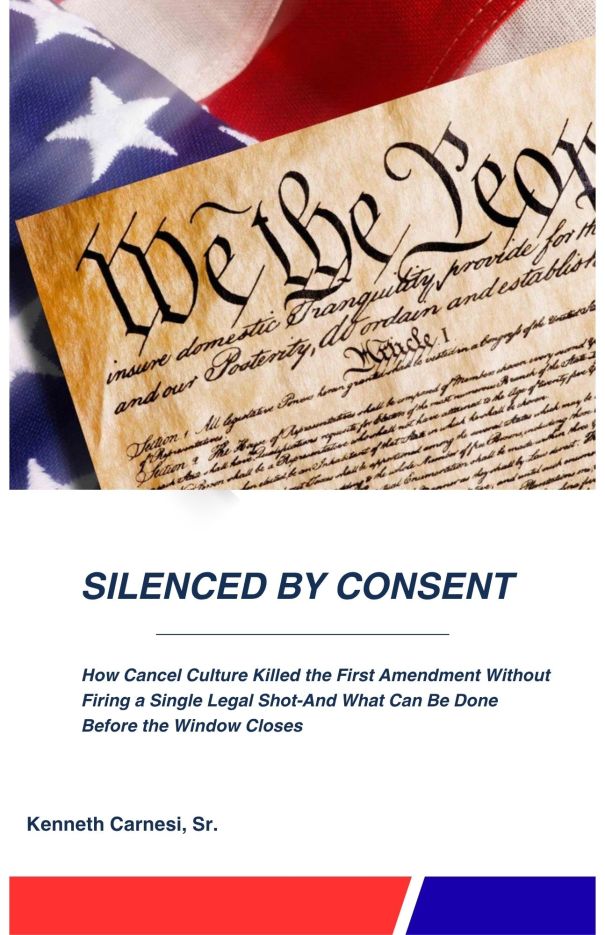
Kenneth Carnesi, Sr.’s Silenced by Consent is a forceful, alarmed, and highly political argument that treats cancel culture not as a passing internet trend but as a serious threat to open debate, institutional courage, and the practical exercise of First Amendment values. The book’s core claim is that speech can be chilled even without formal government censorship: when social punishment, reputational pressure, and professional retaliation become predictable, people self-censor before anyone needs to “fire a shot.”
What the book is trying to say
Carnesi frames cancel culture as a mechanism that can narrow what people are willing to say in public, especially when the cost of speaking becomes loss of status, income, or career opportunity. That argument aligns with broader free-speech concerns raised by commentators who note that cancel culture may not violate the First Amendment in the narrow legal sense but can still weaken the culture of free expression by encouraging fear and silence.
The title’s imagery is deliberate: “silenced by consent” suggests that censorship does not always arrive through explicit bans. It can also emerge through collective participation, passive acceptance, and institutional compliance. In that sense, the book appears to argue that the First Amendment can be hollowed out socially long before it is formally attacked legally.
The book’s central strengths
A vivid warning about speech chill.
The strongest part of Carnesi’s premise is that free expression depends on more than court rulings. If people believe that a mistaken phrase, unpopular opinion, or politically unfashionable stance can trigger coordinated punishment, they will simply stop speaking. That concern is echoed by free-speech advocates, who describe cancel culture as a form of social regulation that can lead to self-censorship.
A focus on consequences, not just doctrine.
Carnesi’s framing is less about legal technicalities and more about lived reality. This makes the book appealing to readers who feel that “you technically still have free speech” misses the practical point: speech rights matter only if people can use them without severe informal punishment
A call for resilience and resistance.
The subtitle’s promise—what can be done before “the window closes”—suggests urgency and action, not only complaint. The broader themes connected to Carnesi’s writing emphasize rebuilding institutions, preserving courage, and refusing to normalize punishment for ordinary disagreement
Where his argument is most controversial
It blurs legal and social censorship.
One recurring criticism of cancel-culture arguments is that they sometimes treat public backlash as equivalent to government suppression. That comparison is imperfect. The First Amendment constrains the state, not private citizens, employers, or online audiences. So while cancel culture can be harsh and chilling, it is not always accurate to describe it as a direct First Amendment violation.
It risks overgeneralizing.
Not every consequence for speech is censorship, and not every public critique is mob justice. Some cases that are labeled “cancel culture” may actually be accountability, especially when institutions or public officials are called out for misconduct. That distinction matters because free expression also includes the right to criticize and challenge harmful conduct.
It can underestimate counter speech.
A major counterargument is that public pushback is itself a form of speech, not necessarily a defect in democracy. Critics of anti-cancel-culture narratives argue that social consequences can sometimes be the means by which communities defend shared values and challenge harmful behavior
The book sits within a broader debate in which some writers argue that cancel culture threatens free speech, while others maintain that countering bad ideas with speech is itself deeply American and sometimes necessary)
What Carnesi says can be done before “the window closes.”
Carnesi’s available book description points to a larger theme of transforming testimony and lived experience into a persuasive story that builds trust and credibility. In this context, the implied remedy is not silence, but active resistance: speaking openly, preserving institutional independence, and refusing to let fear dictate what can be discussed.
More broadly, the kinds of remedies associated with this debate include:
– Defending the right to speak unpopular views without automatic professional ruin
– Encouraging institutions to resist mob pressure and evaluate claims fairly
– Distinguishing accountability for wrongdoing from punishment for mere
– Strengthening norms of civil disagreement so people do not self-censor out of
Overall verdict
Silenced by Consent reads like a warning flare: passionate, urgent, and designed to make readers feel that free expression is eroding not only in law, but in culture, institutions, and everyday conversation. Its main value is that it reminds readers that rights are not self-enforcing; they depend on people and institutions’ willingness to defend them. Its weakness is that it can blur the distinction between genuine censorship and ordinary social consequences, making some of its claims more rhetorical than precise.
To recap, the book’s power lies in its urgency. Whether one agrees with every premise or not, Carnesi is clearly arguing that once fear of punishment becomes normal, speech rights become ceremonial rather than real. The book’s message is that the response must come before silence hardens into habit.


You must be logged in to post a comment.